

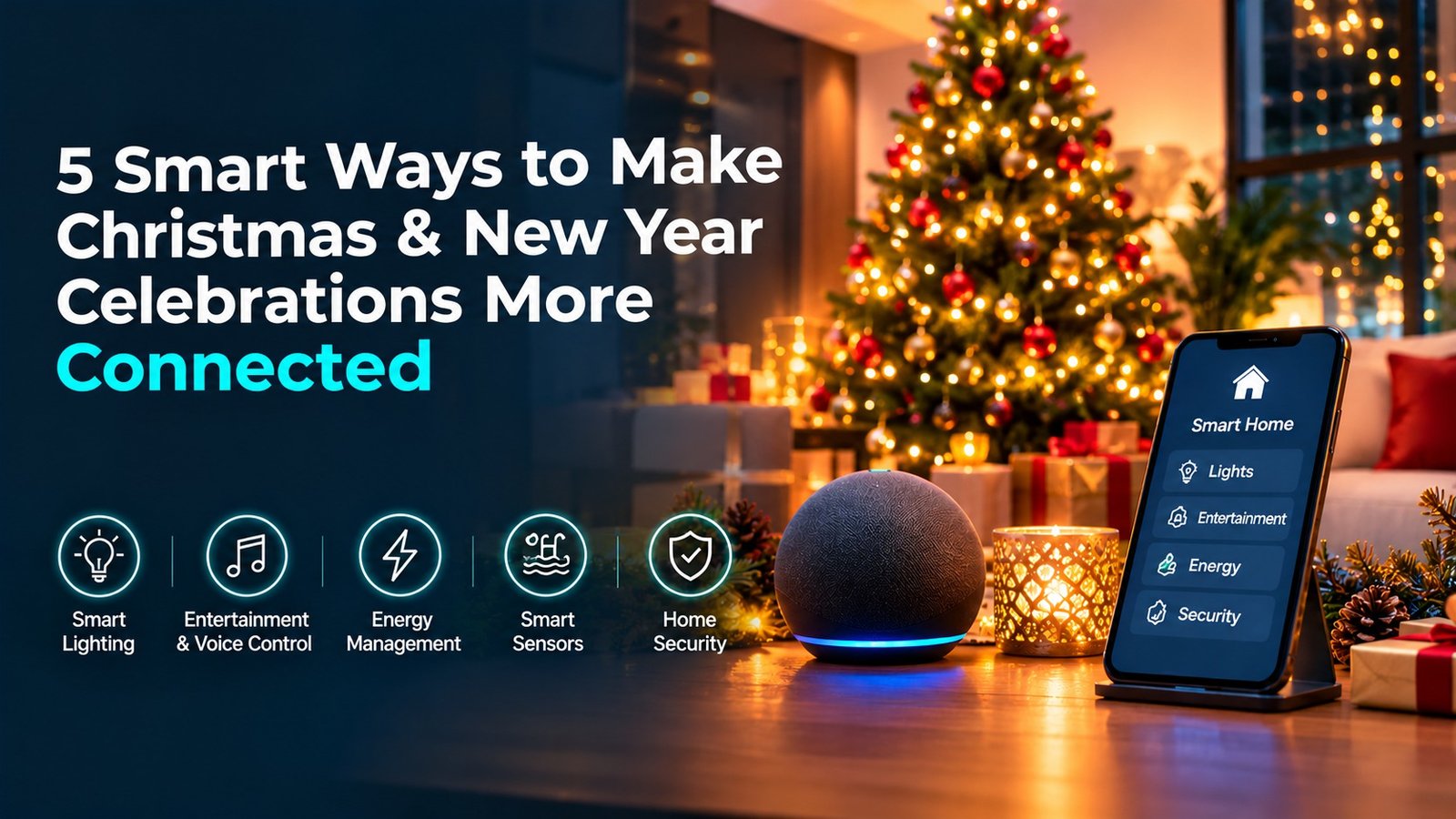
From automated festive scenes and voice-controlled entertainment to smarter energy management and home security, connected technology is changing how people prepare for and enjoy Christmas and New Year. Here are five practical ways the Internet of Things can make celebrations more convenient, personalised and connected — wherever you celebrate.
Introduction: A More Connected Festive Season
Christmas and New Year celebrations bring together family, friends, food, music and decorations. But preparing for the season can also involve a long list of tasks: decorating the home, managing lights, arranging entertainment, keeping an eye on energy use and making sure the house is secure when travelling.
The Internet of Things (IoT) is creating new ways to manage these activities. Connected devices such as smart lights, plugs, speakers, sensors, cameras and home hubs can communicate through apps, wireless networks and automation platforms.
Instead of operating every device separately, homeowners can create routines that coordinate several devices around a particular activity or time of day.
For example, a single festive routine could switch on decorative lights, start a music playlist and adjust selected smart devices. Another routine could turn off non-essential equipment when everyone goes to bed.
The value is not simply in adding more connected gadgets. It lies in making everyday activities easier to manage through automation, remote access and better coordination.
Here are five ways IoT can make Christmas and New Year celebrations smarter.
1. Create a Connected Christmas Tree and Festive Lighting Experience
Decorative lighting is one of the most recognisable parts of Christmas celebrations. Smart lighting adds another layer of control by allowing homeowners to manage colours, brightness, schedules and scenes through a mobile app or compatible voice assistant.
Rather than switching individual lights on and off, connected lighting can be grouped into a single festive scene.
For example:
- Christmas morning: A warm, gentle lighting scene that gradually brightens.
- Family gathering: Decorative lights and selected room lights switch on together.
- Christmas dinner: Softer lighting creates a more relaxed atmosphere.
- New Year’s Eve: Dynamic colour scenes add to the celebration.
- Bedtime: Decorative lighting switches off automatically at a scheduled time.
Smart lighting can also be integrated with motion sensors, where supported, so that selected lights operate only when a room is occupied.
Smart plugs offer another option for controlling conventional decorative lights. They can switch compatible equipment on or off according to a schedule, although users should check the plug’s electrical rating and the manufacturer’s instructions before connecting decorative lighting.
The wider opportunity is the move from individual smart products to coordinated lighting experiences. Ecosystems such as Philips Hue and platforms like Samsung SmartThings allow multiple lighting devices to be grouped and controlled together.
2. Use Smart Plugs and Energy Monitoring to Manage Festive Electricity Consumption
Festive decorations, additional cooking, entertainment equipment and extended gatherings can increase household electricity consumption.
Smart plugs and connected energy-monitoring devices can help homeowners understand and manage some of this additional usage.
Depending on the product, a smart plug may allow users to:
- Switch compatible appliances on or off remotely.
- Set schedules for decorative lights and selected equipment.
- Create routines that turn off devices at specific times.
- Monitor electricity consumption when the device supports energy measurement.
- Check whether connected equipment has been left running.
Consider a simple example. Decorative lights are scheduled to operate for several hours every evening. Instead of relying on someone to remember to switch them off, a schedule can automate the process.
Energy monitoring adds another dimension. It can help users identify which connected devices consume electricity and how usage changes during the festive period.
However, a smart plug does not automatically make an appliance energy efficient. Savings depend on the connected equipment, its power consumption and how the automation is configured. Standby consumption can also vary between devices.
The US Department of Energy explains that some electrical products continue to consume power even when they appear to be switched off. This is commonly referred to as standby power.
The practical lesson is straightforward: use automation to reduce unnecessary operating time, and use energy monitoring to understand consumption rather than assuming every smart device will reduce the electricity bill.
3. Bring Music, Entertainment and Voice Control Together
Music and entertainment are central to many Christmas and New Year gatherings. Connected speakers, smart TVs, streaming devices and voice assistants can make it easier to manage the experience across different rooms.
A connected entertainment setup can support several activities:
- Play a Christmas playlist through compatible speakers.
- Control music playback using voice commands.
- Stream films and festive programmes on connected televisions.
- Group compatible speakers for music across multiple rooms.
- Create routines that combine lighting and entertainment.
Imagine hosting a Christmas dinner. A preconfigured routine could activate the dining-room lighting scene and start a selected playlist. For a New Year’s Eve gathering, another routine could prepare the entertainment setup for the countdown.
Voice assistants can make these interactions more convenient, particularly when people are busy cooking, serving food or hosting guests.
The important distinction is compatibility. Not every speaker, television, streaming service or voice assistant works with every smart home platform. Users should check supported integrations before buying devices.
A well-designed connected entertainment setup should make the experience simpler — not require guests to learn several apps or troubleshoot devices during a celebration.
4. Make Home Management Easier with Smart Sensors and Automation
Festive celebrations often involve changes to normal household routines. Guests may move between rooms, doors may be opened more frequently and homeowners may spend more time away from the property.
Smart sensors can help automate selected household functions.
Motion and occupancy sensors
These can trigger lights in selected rooms, corridors or entryways when movement is detected. They can also help switch lights off when a space is no longer occupied, provided the system is configured appropriately.
Door and window sensors
These can send notifications when a monitored door or window is opened. They can also be used in automation routines, such as switching on selected lights when someone enters the home.
Water-leak sensors
Placed near vulnerable locations such as washing machines, sinks or water heaters, these sensors can notify homeowners when water is detected. This is useful throughout the year, not just during the festive season.
Smart home routines
A single routine can coordinate several compatible devices. For example, an arrival routine could switch on selected lights and adjust other connected equipment. A night routine could turn off decorative lighting and activate selected security settings. The Samsung SmartThings Hub V3 is one example of a central controller that can coordinate compatible devices across the home.
These applications demonstrate an important aspect of IoT: sensors do more than collect information. When connected to an automation platform, they can trigger actions based on what is happening in the home.
5. Keep Your Home Connected and Monitored While Travelling
Christmas and New Year are also popular travel periods. Some families visit relatives, while others take longer holidays.
Smart home technology can provide remote visibility and control while homeowners are away.
A connected home security setup may include:
- Smart video doorbells that allow homeowners to see visitors remotely.
- Connected security cameras with live viewing and motion notifications.
- Door and window sensors that report unexpected activity.
- Smart lighting schedules that make selected rooms appear occupied.
- Remote notifications from compatible sensors and security systems.
For example, a homeowner travelling for the holidays may receive a notification when someone rings the doorbell or when a monitored door is opened.
Smart lighting schedules can also be configured to operate at selected times. This can create the appearance of normal household activity, although lighting automation should not be treated as a substitute for a proper security system.
Remote access also brings responsibility. Cameras and microphones can collect sensitive information, and connected devices depend on accounts, networks and software that need to be secured.
The US Federal Trade Commission recommends securing the home router, changing default device passwords, enabling two-factor authentication where available and keeping device software updated.
Convenience should never come at the cost of basic security and privacy.
The Technology Behind a Connected Festive Home
A connected festive home is not necessarily built around one brand or a single device. It is an ecosystem of products and services that communicate through compatible connectivity standards and automation platforms.
A typical setup may include:
| Component | Role in the connected home |
|---|---|
| Smart lights and plugs | Control lighting and compatible electrical equipment |
| Sensors | Detect motion, door activity, temperature or water |
| Smart speakers | Provide voice control and entertainment |
| Cameras and doorbells | Support remote monitoring |
| Smart home hub or controller | Coordinate compatible devices and automations |
| Mobile applications | Provide setup, monitoring and remote control |
| Connectivity protocols | Enable devices to communicate with one another |
Why interoperability matters
One of the long-standing challenges in the smart home market has been compatibility between products from different manufacturers. The Connectivity Standards Alliance’s Matter standard is intended to address part of this challenge. It provides a common connectivity standard that allows certified devices to work across supported smart home ecosystems.
Matter is designed to improve interoperability, reliability and security. However, certification does not mean that every device feature will work identically across every platform. Supported device types and platform capabilities still matter.
For consumers, checking compatibility before purchasing multiple products can prevent unnecessary complexity and expense. Tuya Smart is one example of an IoT infrastructure provider whose platform supports a wide range of connected products from multiple manufacturers.
What Should You Consider Before Building a Connected Festive Setup?
A connected home does not need to be expensive or complicated. It is usually better to begin with a few useful devices and expand gradually.
Here are five practical considerations:
- Start with a clear purpose — Decide what you want to automate. Buy devices that solve a genuine problem rather than adding technology for its own sake.
- Check compatibility — Look for products that work with your preferred smart home platform. Where possible, consider Matter-certified products, while checking the specific device and feature support.
- Check electrical safety — Smart plugs and switches must be suitable for the connected appliance and its electrical load. For outdoor use, select products specifically rated for the relevant environmental conditions.
- Understand connectivity requirements — Some devices connect directly through Wi-Fi, while others require a compatible hub or controller. Check network coverage, internet requirements and what happens if the internet connection is interrupted.
- Take security seriously — Use strong, unique passwords, enable multi-factor authentication where available, install software updates and review the privacy settings of cameras, microphones and other connected devices.
Conclusion: The Future of Festive Celebrations Is Connected
Christmas and New Year celebrations will always be about people, traditions and shared experiences. Technology cannot replace those things, but it can make the preparation and management of celebrations easier.
Connected lighting can create personalised environments. Smart plugs and energy monitoring can help manage electricity use. Voice assistants and connected entertainment systems can simplify hosting. Sensors can automate everyday tasks, while smart security devices can provide remote visibility when families travel.
The bigger shift is from controlling individual gadgets to creating a connected environment in which devices work together around people’s routines.
As interoperability standards mature and more products become compatible across platforms, building a connected home is likely to become simpler.
This festive season, the smartest home may not be the one with the most devices. It may be the one where the right devices work together seamlessly.
Further Reading | IoT News Portal
Explore related articles in this series and connected technology on IoT News Portal:
- 5 Smart Ideas for a Smarter Christmas and New Year in Warm Climates — IoT for outdoor and summer celebrations
- 5 Smart Ideas for a Smarter Christmas and New Year in Cold and Snowy Climates — Smart heating, frozen-pipe detection and winter home management
- Philips Hue — Connected lighting ecosystem
- Samsung SmartThings — Smart home automation platform
- Samsung SmartThings Hub V3 — Connected device management
- Tuya Smart — IoT infrastructure for connected products
Primary Research Sources
- Connectivity Standards Alliance — Matter
- Connectivity Standards Alliance — Matter FAQs
- US Department of Energy — Measuring Standby Power
- US Federal Trade Commission — Securing Your Internet-Connected Devices at Home
- US Federal Trade Commission — How to Secure Your Home Wi-Fi Network
- UK National Cyber Security Centre — Smart Devices: Using Them Safely in Your Home
Editorial note: Energy savings and security benefits depend on device specifications, configuration, household behaviour and network security. The article deliberately avoids promising fixed savings or implying that smart devices guarantee home security.