
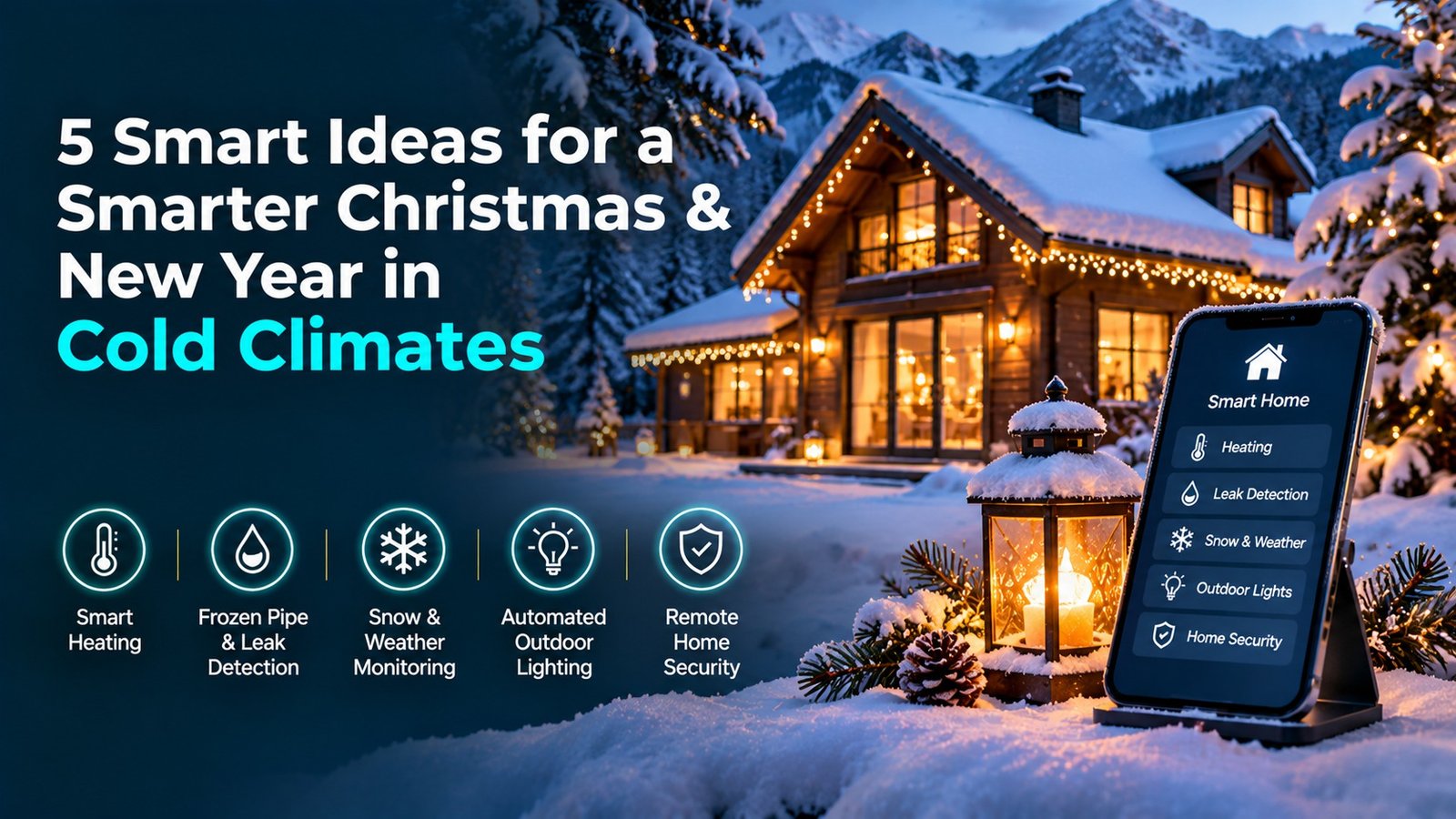
In North America and Northern Europe, Christmas and New Year often coincide with freezing temperatures, snowfall and shorter days. Connected thermostats, environmental sensors, smart lighting and remote monitoring systems can help households stay comfortable, protect their properties and manage energy more intelligently during the winter festive season.
Introduction: When Winter Meets the Connected Home
For many people, Christmas means snow-covered streets, decorated homes, warm indoor gatherings and long winter evenings.
But winter celebrations also bring practical challenges. Heating systems work harder, pipes can freeze, snow and ice create outdoor hazards, and homeowners travelling for the holidays may leave properties unattended in difficult weather conditions.
The Internet of Things (IoT) is helping address some of these challenges through connected thermostats, environmental sensors, automated lighting, smart security systems and remote monitoring.
These technologies allow homeowners to monitor conditions, automate selected tasks and receive alerts when something needs attention.
The goal is not simply to make a home more connected. It is to make it more responsive to changing winter conditions.
Here are five practical ways IoT can make Christmas and New Year smarter in cold and snowy climates.
1. Use Smart Thermostats to Manage Winter Heating
Heating is one of the major energy requirements for homes in colder regions. During the festive season, household routines may change as families host guests, travel or spend more time indoors.
Smart thermostats can help manage heating schedules around these changing routines.
Depending on the model and heating system, connected thermostats can provide:
- Remote temperature adjustment through mobile applications.
- Scheduled heating based on household routines.
- Temperature monitoring.
- Automated adjustments based on occupancy or other supported inputs.
- Energy usage information and heating reports.
For example, a homeowner hosting Christmas dinner could adjust the heating before guests arrive. A family travelling for New Year could modify its heating schedule remotely rather than maintaining the usual comfort temperature throughout the day.
Some systems also support geofencing, where heating settings can respond to the location of household members’ smartphones.
However, smart thermostats are not universally compatible with every heating system. Compatibility with boilers, heat pumps, radiators and existing HVAC controls must be checked before purchase.
It is also important not to turn heating down so far that pipes or vulnerable parts of a property are exposed to freezing conditions.
The US Department of Energy recommends using programmable thermostats to reduce heating and cooling when people are away or asleep, where appropriate for the system.
The benefit of smart heating is therefore not simply remote control. It is the ability to align heating operation with actual household requirements. Platforms such as Samsung SmartThings can integrate thermostat control with other smart home automations.
2. Detect Frozen Pipes and Water Leaks Before They Cause Damage
Freezing temperatures can create serious problems for residential plumbing.
When water inside pipes freezes, it expands. This can create pressure that damages pipes and may eventually cause them to burst. When temperatures rise and the ice melts, water damage can follow.
Smart environmental sensors can help homeowners identify some risks earlier.
A connected winter monitoring setup may include:
Temperature sensors
Placed near vulnerable plumbing areas, these can alert homeowners when temperatures fall below a configured threshold.
Water-leak sensors
Installed near washing machines, sinks, water heaters or other vulnerable locations, these can notify homeowners when water is detected.
Smart water shut-off valves
Some connected systems can automatically close a compatible main water valve when a leak is detected.
Remote notifications
Alerts can help homeowners respond even when they are away from the property.
Consider a family travelling during the Christmas break. A temperature sensor in a vulnerable utility area could notify them if the temperature drops unexpectedly. A leak sensor could provide an early warning if water is detected near plumbing equipment.
These systems do not guarantee that pipes will not freeze or that water damage will be prevented. Sensor placement, connectivity, power supply and the speed of response all matter.
The US Department of Energy and other public safety organisations recommend protecting exposed pipes and maintaining appropriate indoor temperatures during freezing weather.
Smart monitoring should complement these basic precautions, not replace them.
3. Automate Outdoor Lighting for Short Winter Days and Long Nights
Winter brings shorter daylight hours in many northern regions. Outdoor lighting becomes important not only for festive decoration but also for visibility around entrances, pathways, driveways and gardens.
Connected lighting can make outdoor spaces easier to manage.
Smart outdoor lights can be configured to:
- Switch on around sunset.
- Operate according to seasonal schedules.
- Respond to motion near selected entry points.
- Adjust brightness through compatible applications.
- Create festive lighting scenes for Christmas and New Year.
- Switch off automatically at selected times.
For example, pathway lighting could turn on at dusk and brighten when movement is detected. Decorative Christmas lights could operate on a separate schedule, preventing them from remaining switched on throughout the night.
Connected lighting can also be coordinated with door sensors and security systems. When a monitored door is opened, selected lights may switch on automatically.
Outdoor equipment must be suitable for winter exposure. Snow, ice, moisture and low temperatures can affect devices that are not designed for those conditions.
Check the manufacturer’s operating-temperature range, outdoor protection rating and installation requirements before using smart lighting in exposed locations.
The wider benefit is that lighting becomes responsive to time, movement and household activity rather than relying entirely on manual switching.
4. Monitor Snow, Ice and Outdoor Conditions with Connected Sensors
Snow and ice can affect driveways, walkways, roofs, gardens and other outdoor areas.
For homeowners, knowing what is happening outside can be useful when deciding whether to clear a pathway, check a roof or prepare for changing weather.
Connected weather stations and environmental sensors can provide information such as:
- Outdoor temperature.
- Humidity.
- Rainfall.
- Wind conditions.
- Snowfall, where supported by the equipment.
- Ground or surface temperature, where suitable sensors are installed.
Some advanced systems can integrate environmental readings with automation platforms. For example, a configured temperature sensor may trigger an alert when conditions approach freezing. A compatible system could also use environmental information to activate selected equipment or notify homeowners to inspect vulnerable outdoor areas.
Smart driveway and snow-melting systems are another application. These systems can use temperature and moisture sensors to control heating elements in selected outdoor surfaces.
Instead of operating continuously, a compatible system can activate when the required conditions are detected.
However, snow-melting installations can consume substantial electricity or fuel. Their economics depend on the installation, climate, operating hours and energy source.
It is also important to distinguish between weather monitoring and actual snow-removal automation. A weather station may report conditions, but it does not physically clear snow.
The practical value of connected environmental monitoring is better awareness and more timely action.
5. Keep Your Home Protected While Travelling During Winter
Christmas and New Year are popular travel periods. Families may leave their homes for several days to visit relatives or take holidays.
In cold regions, an unattended property can face additional risks from freezing temperatures, heating failures, water leaks and winter weather.
A connected home monitoring system can provide remote visibility into some of these conditions.
Useful components include:
- Smart cameras and doorbells — Allow homeowners to check selected areas of their property remotely and receive activity notifications.
- Door and window sensors — Report activity at monitored entry points and can trigger compatible lighting or security routines.
- Temperature sensors — Help identify unusually low temperatures in vulnerable areas.
- Water-leak sensors — Provide alerts when water is detected near plumbing or appliances.
- Smart thermostats — Allow heating schedules and temperature settings to be monitored and adjusted remotely.
Some systems can also coordinate heating, lighting and security routines to maintain selected household settings while the property is unoccupied. The Samsung SmartThings Hub V3 is one example of a connected home controller that can coordinate multiple device types around winter scenarios.
However, remote monitoring is not a substitute for proper winter preparation. Homeowners should arrange appropriate property checks, maintain heating systems and take steps to protect vulnerable plumbing before travelling.
Connected systems also depend on power and internet connectivity. A device that loses power or network access may not deliver notifications when needed.
The Technology Behind a Connected Winter Home
The applications above rely on a combination of sensors, connected devices, controllers and automation platforms.
A typical connected winter home may include:
| Technology | Winter application |
|---|---|
| Smart thermostats | Heating schedules and remote temperature control |
| Temperature sensors | Monitoring vulnerable areas and pipes |
| Water-leak sensors | Early notification of detected leaks |
| Smart water shut-off valves | Automatic water isolation in supported systems |
| Smart outdoor lighting | Seasonal schedules and motion-based lighting |
| Weather stations | Monitoring outdoor conditions |
| Snow-melting controllers | Managing compatible heated outdoor surfaces |
| Cameras and door sensors | Remote property monitoring |
These devices may communicate through Wi-Fi, Bluetooth, Zigbee, Thread or other supported technologies. Standards such as Matter are also helping improve interoperability across compatible smart home products. Tuya Smart offers one example of an IoT platform supporting a range of sensor and automation products.
The Role of Predictive and AI-Enabled Home Automation
A further development in connected home technology is the use of analytics and artificial intelligence to interpret information from multiple devices. Traditional automation usually follows predefined rules. More advanced systems can use additional information — such as occupancy patterns, historical temperature readings, weather forecasts and energy consumption — to help optimise how a home operates.
Potential applications include predicting heating requirements based on weather forecasts, identifying unusual changes in energy consumption, detecting patterns that may indicate equipment problems, and recommending more efficient heating schedules.
It is important not to assume that every smart thermostat or home hub uses AI. Many useful automations operate through straightforward rules and sensor inputs. The Smart City Barcelona example shows how IoT-based sensor networks and automation can operate at scale — the same principles apply to individual homes in winter climates.
What to Consider Before Building a Connected Winter Home
Cold-weather environments place additional demands on connected equipment. Before investing, consider the following:
- Heating system compatibility — Check whether a smart thermostat supports the existing boiler, heat pump, radiator or HVAC system.
- Sensor placement — Temperature and leak sensors should be placed near the areas where problems are most likely to occur.
- Operating temperature — Outdoor devices must be designed to operate within the temperature range expected at the installation location.
- Power and network reliability — Check battery life, backup power options and what happens when internet connectivity is lost.
- Water shut-off compatibility — Automatic water shut-off systems must be compatible with the home’s plumbing and installed correctly.
- Security and privacy — Use strong passwords, enable multi-factor authentication where available and keep connected devices updated.
- Do not replace basic winter preparation — Insulate vulnerable pipes, maintain heating equipment, clear outdoor hazards and arrange property checks when travelling. IoT should complement these measures.
Conclusion: A Home That Responds to Winter
In cold and snowy regions, the festive season brings more than decorations and celebrations. It also brings changing heating requirements, freezing temperatures, snow, ice and additional property-management challenges.
IoT technology can help homeowners respond to these conditions more effectively. Smart thermostats help manage heating schedules. Temperature and water-leak sensors provide useful alerts. Connected outdoor lighting improves visibility during long winter evenings. Environmental monitoring helps homeowners understand outdoor conditions, while remote monitoring provides visibility when families travel.
The bigger shift is towards homes that do more than respond to manual commands. They can use sensor information, automation and connected platforms to react to changing conditions.
As smart home technology becomes more interoperable and intelligent, winter home management may become increasingly proactive.
The smartest winter home is not necessarily the one with the most connected devices. It is the one that uses the right technology to keep people comfortable, informed and prepared.
Further Reading | IoT News Portal
Explore related articles in this series and connected technology on IoT News Portal:
- 5 Smart Ways to Make Christmas & New Year Celebrations More Connected — Universal IoT ideas for the festive season
- 5 Smart Ideas for a Smarter Christmas and New Year in Warm Climates — IoT for outdoor and summer celebrations
- Samsung SmartThings — Smart home automation platform
- Samsung SmartThings Hub V3 — Connected device management
- Tuya Smart — IoT infrastructure for connected products
- Smart City Barcelona — How IoT is transforming urban infrastructure
Primary Research Sources
- US Department of Energy — Programmable Thermostats
- US Department of Energy — Thermostats
- US Department of Energy — Weatherization and Energy Efficiency
- US Federal Emergency Management Agency — Winter Weather
- US Federal Trade Commission — Securing Your Internet-Connected Devices at Home
- Connectivity Standards Alliance — Matter
Editorial note: Smart monitoring can provide early warnings but cannot guarantee prevention of frozen pipes, leaks, snow accumulation or property damage. Snow-melting systems can have significant energy requirements. Product capabilities and compatibility must be verified before making specific product claims.