
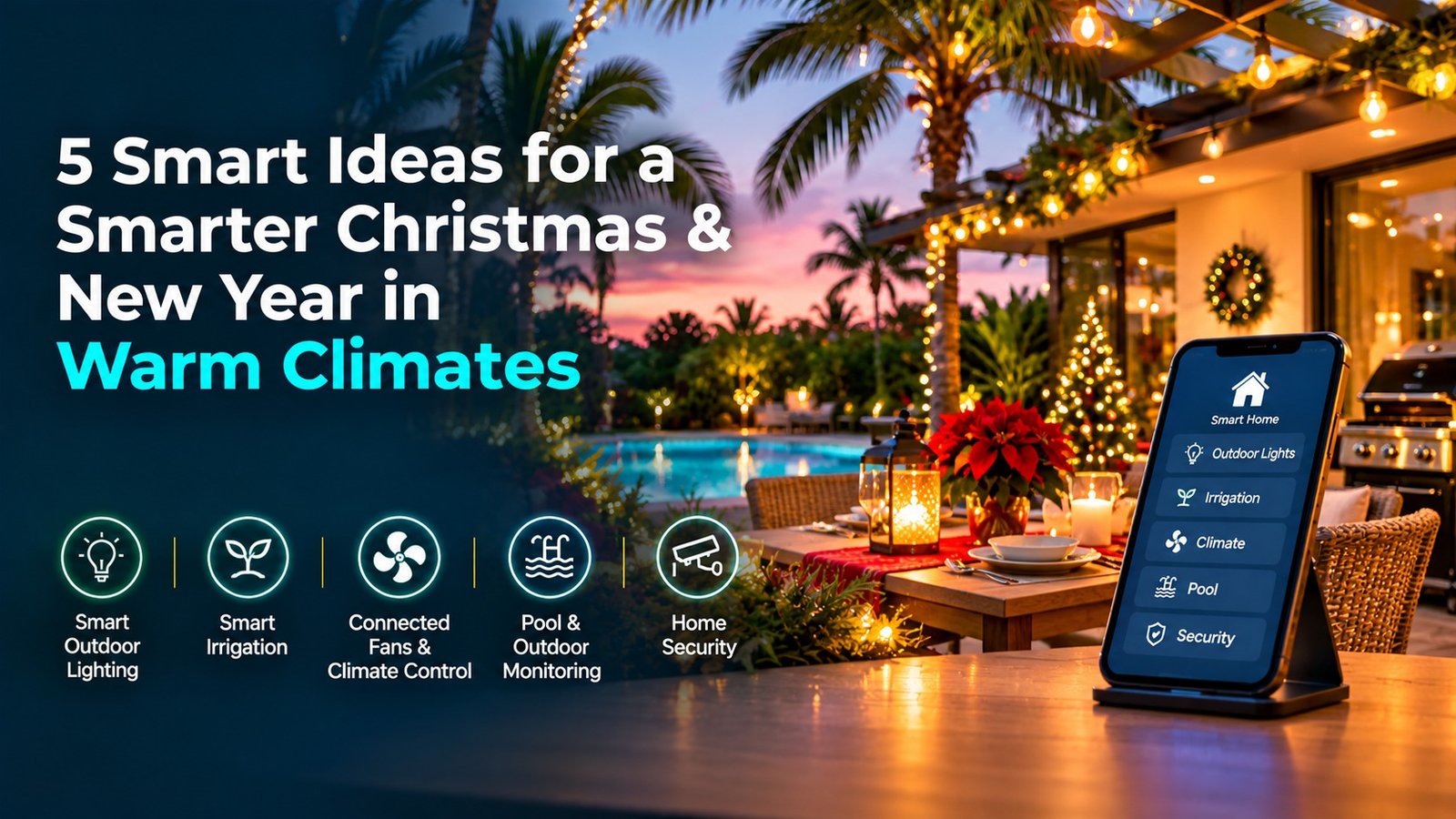
Christmas in Australia, New Zealand, India, South Africa and other warm-weather destinations looks very different from a snowy winter celebration. Outdoor gatherings, gardens, swimming pools and warm evenings create different opportunities for connected technology. Here are five practical ways IoT can make festive celebrations more comfortable, efficient and enjoyable.
Introduction: A Different Kind of Christmas
Christmas is often pictured with snow-covered streets, fireplaces and warm indoor gatherings. But for millions of people across the Southern Hemisphere and tropical regions, December means sunshine, outdoor celebrations and warm-weather activities.
In Australia, Christmas falls during summer. Families may celebrate with backyard barbecues, outdoor dining, garden parties and trips to the beach. In India and other warm regions, festive gatherings may extend to balconies, terraces, gardens and outdoor community spaces.
These environments create a different set of needs for smart home technology.
Instead of focusing primarily on heating and protection from freezing temperatures, connected devices can help manage outdoor lighting, irrigation, ventilation, pools, energy consumption and home security.
The Internet of Things (IoT) brings these systems together through sensors, connected devices, mobile applications and automation platforms.
Here are five smart ideas for making Christmas and New Year celebrations more connected in warm climates.
1. Create Smarter Outdoor Lighting for Evening Celebrations
Outdoor celebrations are an important part of Christmas and New Year in many warm-weather countries. Gardens, patios, balconies, terraces and outdoor dining areas often become extensions of the home.
Smart outdoor lighting can make these spaces more adaptable.
Connected lights allow users to control brightness, colours and operating schedules through mobile applications. Depending on the products and platform, lighting can also respond to motion, sunset times or other sensor inputs.
Consider a few practical scenarios:
- Christmas dinner: Switch on warm ambient lighting around the garden and dining area.
- Family gathering: Activate a predefined outdoor lighting scene.
- New Year’s Eve: Create a more colourful lighting setup for the celebration.
- After the party: Automatically switch off decorative lights at a scheduled time.
- Security: Use motion-triggered lighting around selected entry points.
Smart lighting can also be integrated with other home automation routines. For example, an evening routine could switch on outdoor lights, adjust selected indoor lights and activate compatible security settings. Platforms such as Philips Hue and Samsung SmartThings support this kind of multi-device coordination.
Outdoor installations require particular attention to safety. Choose products designed and rated for outdoor exposure, use suitable weatherproof connections and follow the manufacturer’s installation instructions. A product intended for indoor use should not be placed outdoors simply because it is marketed as a smart light.
The opportunity is to make outdoor spaces more flexible without having to manage every light manually.
2. Automate Garden Irrigation and Water Management
Gardens often become important gathering spaces during the festive season. However, warm temperatures and increased outdoor activity can put additional pressure on garden maintenance.
Smart irrigation systems can help manage watering more intelligently.
A connected irrigation controller can operate watering schedules through an application. More advanced systems may use soil-moisture sensors or local weather information to adjust watering according to actual conditions.
Potential applications include:
- Scheduling garden watering during cooler parts of the day.
- Monitoring soil moisture in selected garden areas.
- Adjusting watering schedules when rainfall is detected or forecast.
- Managing different watering zones independently.
- Controlling irrigation remotely while travelling.
For example, a homeowner hosting Christmas celebrations in the garden can schedule irrigation outside the hours when guests are using the space.
A family travelling over the New Year period may also be able to monitor and control a compatible irrigation system remotely.
The benefits depend on the system’s sensors, local conditions and configuration. A timer-based controller alone does not know whether plants actually need water. Soil-moisture sensing and weather-aware scheduling can provide more useful information.
Water conservation is an important consideration in many warm regions. The US Environmental Protection Agency’s WaterSense programme provides guidance on water-efficient irrigation controllers and technologies that respond to weather or soil conditions.
Smart irrigation is therefore not just about convenience. It can help homeowners make more informed decisions about outdoor water use.
3. Make Outdoor Comfort Smarter with Connected Fans and Climate Control
Warm evenings can be enjoyable, but outdoor gatherings may become uncomfortable when temperatures and humidity remain high.
Connected fans and climate-control devices can help manage indoor and selected covered outdoor spaces.
Smart ceiling fans, compatible controllers and connected air-conditioning systems can allow users to adjust settings remotely or through scheduled routines.
For example:
- Switch on selected fans before guests arrive.
- Adjust fan speeds during a gathering.
- Set air-conditioning schedules for indoor dining areas.
- Create routines that coordinate lighting and climate settings.
- Monitor indoor temperature and humidity through connected sensors.
Temperature and humidity sensors can provide useful information about indoor conditions. When integrated with compatible automation systems, they may trigger fans or climate-control equipment when conditions reach configured thresholds.
However, automation must account for the actual environment. A temperature sensor placed in direct sunlight may provide misleading readings, while a smart fan controller must be compatible with the fan and its electrical system.
It is also important to distinguish between ventilation and cooling. A fan can improve comfort by moving air, but it does not reduce the actual air temperature.
For households using air-conditioning, smart controls can make it easier to manage operating schedules and avoid unnecessary cooling when rooms are unoccupied. Actual energy savings depend on the equipment, settings, insulation and household behaviour.
4. Bring Smart Monitoring to Pools and Outdoor Living Spaces
Swimming pools and outdoor entertainment areas are common features of homes in parts of Australia, South Africa and other warm-weather destinations.
These spaces can involve several maintenance tasks, including water-quality checks, temperature monitoring, filtration and equipment scheduling.
Connected pool-monitoring systems can make some of these tasks easier.
Depending on the product, a smart pool system may support:
- Monitoring selected water-quality parameters.
- Tracking pool temperature.
- Managing filtration schedules.
- Controlling compatible pumps and lighting.
- Sending alerts when readings move outside configured limits.
Connected sensors can also be useful beyond pools. Outdoor temperature, humidity and weather sensors can provide information that helps homeowners manage irrigation, ventilation and outdoor activities.
There is an important limitation: not every pool sensor measures every water-quality parameter, and automated monitoring should not replace appropriate maintenance, testing and safe pool practices.
The broader IoT opportunity is to move from occasional manual checks towards more continuous visibility of outdoor environments and equipment.
5. Keep Outdoor Homes and Holiday Properties Connected
Warm-weather Christmas celebrations often involve travel, outdoor events and time away from home. Some families visit relatives, while others spend the holiday period at beach houses, holiday homes or other properties.
Connected monitoring and security systems can help homeowners maintain visibility when they are away.
Smart cameras and video doorbells
These can provide remote video access and notifications when movement or doorbell activity is detected.
Door and window sensors
These can report activity at monitored entry points and trigger compatible automation routines.
Outdoor motion sensors
These can activate selected lighting or send alerts when movement is detected in designated areas.
Smart irrigation monitoring
This can help homeowners check watering schedules while travelling, particularly where connected controllers provide remote access.
Environmental sensors
Depending on the installation, sensors can report temperature, humidity or water leaks and notify homeowners when readings cross configured thresholds.
A connected holiday home can also use lighting schedules to create the appearance of normal activity while unoccupied.
As with any connected security system, privacy and cybersecurity matter. Cameras should be positioned responsibly, accounts protected with strong passwords and multi-factor authentication where available, and device software kept up to date.
Remote monitoring provides visibility and convenience, but it should complement — not replace — appropriate physical security and responsible property management.
The Connected Outdoor Home: How the IoT Ecosystem Works
The five applications above may appear different, but they share a common foundation: connected devices collect information, communicate with controllers or platforms, and allow users to monitor or automate selected actions.
A typical connected outdoor setup may include:
| Technology | Example application |
|---|---|
| Smart outdoor lights | Garden, patio and balcony lighting |
| Motion and light sensors | Automated outdoor lighting |
| Soil-moisture sensors | Garden irrigation |
| Smart irrigation controllers | Scheduled and adaptive watering |
| Temperature and humidity sensors | Outdoor and indoor comfort monitoring |
| Smart fan and AC controllers | Connected climate management |
| Pool sensors and controllers | Pool monitoring and equipment scheduling |
| Cameras and door sensors | Remote property monitoring |
Connectivity may use Wi-Fi, Bluetooth, Zigbee, Thread or other supported technologies. Standards such as Matter are also helping improve interoperability between compatible smart home products. Tuya Smart is one example of an IoT infrastructure provider whose platform supports a range of outdoor and indoor connected devices.
Why Australia Deserves Special Attention
Australia offers a particularly useful example of how climate changes the way people use technology during Christmas. December is the beginning of summer in Australia. Christmas celebrations often take place outdoors, with barbecues, garden gatherings, swimming pools and evening entertainment.
This makes several IoT applications especially relevant: outdoor-rated smart lighting, connected irrigation, smart fans and climate control, pool monitoring and remote monitoring for holiday homes. These technologies are relevant across many warm-weather regions, including parts of India, New Zealand, South Africa and Southeast Asia.
What to Consider Before Investing in Smart Outdoor Technology
Outdoor connected devices operate in more demanding environments than many indoor products. Before buying, consider the following:
- Weather resistance — Check the product’s IP rating and whether it is designed for exposure to rain, dust, humidity and sunlight.
- Electrical safety — Use equipment suitable for the intended outdoor application. Follow local electrical regulations and use qualified professionals for installations where required.
- Water and power management — For irrigation and pool equipment, check sensor capabilities, control limits and compatibility with existing systems.
- Connectivity coverage — Outdoor spaces may be beyond the reliable range of an indoor Wi-Fi router. Check coverage and whether additional networking equipment or a hub is required.
- Platform compatibility — Confirm that devices work with the smart home platform you intend to use.
- Privacy and security — Use secure accounts, update device software and review camera access and notification settings.
Conclusion: A Smarter Summer Celebration
Christmas and New Year celebrations look different around the world. In warm-weather regions, outdoor living, gardens, pools and evening gatherings are often central to the experience.
IoT technology can help make these spaces easier to manage. Connected lighting creates flexible outdoor environments, smart irrigation helps manage water use, climate controls improve comfort, pool monitoring supports maintenance and connected security provides remote visibility.
The larger opportunity is the integration of these technologies. Instead of managing every device separately, homeowners can build connected routines that respond to their environment and daily activities.
As smart home technology evolves, the idea of a connected home is expanding beyond indoor rooms. Gardens, terraces, pools and outdoor entertainment areas are becoming part of the same intelligent ecosystem.
For a summer Christmas, that may be the smartest gift technology can offer.
Further Reading | IoT News Portal
Explore related articles in this series and connected technology on IoT News Portal:
- 5 Smart Ways to Make Christmas & New Year Celebrations More Connected — Universal IoT ideas for the festive season
- 5 Smart Ideas for a Smarter Christmas and New Year in Cold and Snowy Climates — Smart heating, frozen-pipe detection and winter home management
- Philips Hue — Connected lighting ecosystem
- Samsung SmartThings — Smart home automation platform
- Tuya Smart — IoT infrastructure for connected products
- Smart City Barcelona — How IoT is transforming urban infrastructure
Primary Research Sources
- Australian Bureau of Meteorology — Climate and seasonal information
- US Environmental Protection Agency — WaterSense Water-Smart Landscaping
- US Environmental Protection Agency — WaterSense at Work
- Connectivity Standards Alliance — Matter
- US Federal Trade Commission — Securing Your Internet-Connected Devices at Home
Editorial note: Product capabilities vary by manufacturer and model. Do not imply that every smart irrigation controller uses soil-moisture sensors, that every pool system monitors all water-quality parameters, or that smart fans reduce room temperature. Verify specific product claims before naming or recommending products.