
A practical framework for turning regional ambition into measurable outcomes through governance reform, coordinated planning, bankable infrastructure, technology, private investment and accountable execution.
Introduction: The real test begins after the vision
Delhi-NCR does not lack development plans, infrastructure projects, technology pilots or policy announcements.
It has Metro and regional rapid transit networks, expressways, industrial corridors, smart-city projects, sewage-treatment plants, waste-processing facilities, renewable-energy initiatives and an expanding digital infrastructure ecosystem.
It also has institutions with mandates covering regional planning, air quality, transport, water, electricity, municipal services and urban development.
Yet the region continues to experience problems that cross administrative boundaries: severe seasonal air pollution, pressure on water resources, fragmented public transport, urban flooding, waste-management challenges, uneven public services and unplanned growth at the urban fringe.
This raises a more important question than whether Delhi-NCR needs another smart-city vision.
Can the region make its existing institutions, infrastructure, budgets and technology work together to deliver measurable improvements in everyday life?
That is the challenge of Delhi-NCR 2040.
The previous articles in this series examined the major building blocks:
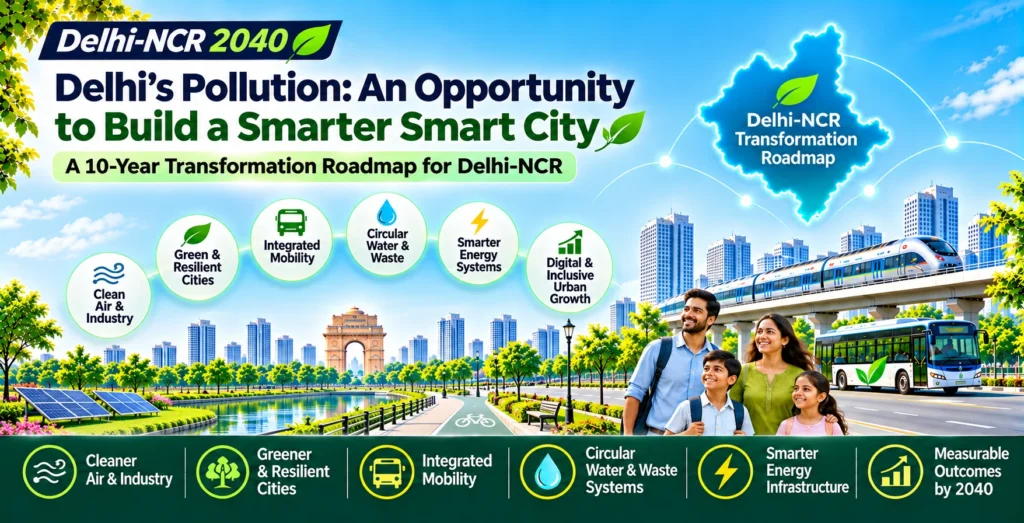
- Turning the pollution crisis into a catalyst for regional transformation.
- Using climate intelligence to improve urban greening.
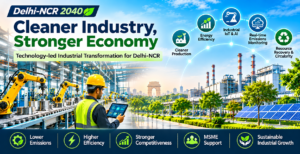
- Enabling cleaner industrial growth without undermining jobs and economic activity.
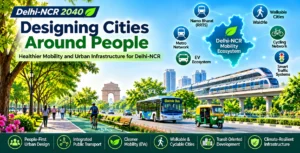
- Designing mobility and infrastructure around people.
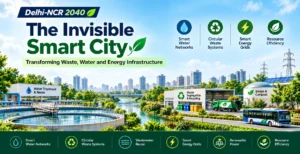
- Transforming water, waste and energy into connected, circular utility systems.
This final article brings those themes together into an execution framework.
It proposes a ten-year transformation programme, beginning in 2027 and running through 2036, followed by a four-year consolidation period to 2040.
The roadmap is a strategic proposal by IOT News Portal. It is not an announced government programme, approved budget or official NCR target.
1. Start with the scale of the challenge
The National Capital Region is much larger than the city of Delhi.
According to the Ministry of Housing and Urban Affairs, the NCR spans approximately 55,083 square kilometres across the NCT of Delhi and 27 districts in Haryana, Uttar Pradesh and Rajasthan. It includes 230 urban settlements and 11,784 villages.
The Ministry’s June 2026 update reported a regional population of approximately 7.86 crore, projected to reach 14.73 crore by 2041. It also estimated that the region contributes around 8% of India’s GDP.
These figures have major implications.
The region must accommodate millions of additional residents while expanding housing, employment, transport, water supply, sanitation, energy, waste processing, healthcare, education and public spaces.
The challenge is not simply to build more infrastructure. It is to ensure that infrastructure is located correctly, connected to other systems, funded sustainably and operated effectively.
1.1 The regional nature of the problem
Delhi’s economic and environmental systems are closely connected to surrounding urban centres.
Gurugram is an important corporate and technology hub. Noida and Greater Noida have significant manufacturing, technology and commercial activity. Ghaziabad and Faridabad are major industrial and residential centres. Other NCR towns are expanding as employment, housing and logistics destinations.
People, vehicles, goods, water, energy and pollution move across these boundaries.
A decision taken by one municipality can affect another. A transport corridor can reshape development patterns across several cities. Industrial emissions and regional weather conditions can influence air quality beyond the location where emissions originate.
This is why city-by-city projects, without regional coordination, will not be sufficient.
1.2 Regional planning must become operational
The NCR Planning Board’s Regional Plan 2041 is intended to provide a long-term spatial and infrastructure framework.
At its 42nd meeting on 16 June 2026, the NCRPB discussed the updated Draft Regional Plan 2041. The updated draft had been shared with the constituent states in January 2026, and responses had been incorporated. The Board decided that the plan would be notified after examination of issues raised and completion of administrative requirements.
The same meeting discussed four proposed semi-greenfield, mixed-use transit-oriented growth nodes, referred to as Namo Cities, along selected existing or proposed Namo Bharat stations. It also discussed a performance-linked incentive scheme to encourage green cover.
These are significant planning directions. However, a draft plan and a proposed scheme should not be confused with completed projects or notified implementation arrangements.
The next requirement is to translate regional planning into:
- Approved spatial and infrastructure priorities.
- Clear responsibilities across states and agencies.
- Funded project pipelines.
- Timelines and implementation milestones.
- Common data and performance standards.
- Transparent progress reporting.
A regional plan must become a working investment and delivery framework, not remain only a planning document.
2. The central problem: fragmented execution
Delhi-NCR has multiple institutions with important responsibilities.
The NCR Planning Board coordinates regional planning. The Commission for Air Quality Management addresses air pollution across the NCR and adjoining areas. NCRTC develops and operates regional rapid transit. DMRC operates Metro services. Municipal corporations manage local services. State departments and development authorities control important aspects of transport, land use and infrastructure.
Water, sewerage, electricity, roads, industrial development and environmental compliance involve further agencies.
The presence of multiple institutions is not itself a problem. Large metropolitan regions require specialised organisations.
The problem arises when responsibilities overlap, information is not shared, funding is disconnected from outcomes, and no institution is accountable for the complete result.
2.1 A practical example: air pollution
Air pollution cannot be managed through one department or one city.
It involves transport, industry, construction and demolition, road dust, waste burning, power generation, agriculture-related burning, fuel quality, enforcement and regional meteorological conditions.
CAQM’s February 2026 review of source-apportionment studies covering 2015–2025 identified PM2.5 as the dominant pollutant affecting Delhi’s air quality and highlighted both local emissions and regional movement of pollution.
The Commission’s work also involves directions to multiple state governments and agencies.
This illustrates the nature of the challenge: the problem is regional, but many of the actions required to address it are delivered by different authorities.
A regional air-quality strategy therefore needs more than monitoring stations and emergency restrictions. It requires year-round sectoral plans, assigned owners, reliable compliance data and consequences for non-performance.
2.2 A practical example: public transport
A Metro or RRTS corridor may cross multiple administrative jurisdictions.
But feeder buses, roads, footpaths, parking, station access, ticketing and local traffic management may be controlled by different agencies.
The passenger experiences one journey. The administration manages several separate services.
The result can be a technically excellent transport corridor with an inconvenient door-to-door journey.
2.3 A practical example: water and waste
A municipality may invest in sewage-treatment capacity without ensuring that all sewage reaches the plant or that treated water has a reliable reuse market.
A waste-processing facility may be constructed without adequate source segregation or dependable feedstock.
A smart meter may be installed without a utility having the operational capacity to respond to abnormal consumption or network losses.
In each case, the asset exists, but the intended public outcome may remain incomplete.
Delhi-NCR’s next phase should be measured by outcomes delivered across systems, not by projects announced or equipment installed.
3. Establish a regional delivery architecture
The region does not necessarily need another large authority.
It needs a practical mechanism through which existing institutions can coordinate priorities, share information, resolve dependencies and report progress.
3.1 Build on existing institutions
The NCRPB, CAQM, state governments, municipal corporations, development authorities and sector-specific agencies already have defined mandates.
The first step should be to map these mandates against the outcomes required for Delhi-NCR 2040.
For each major outcome, identify:
- The institution accountable for delivery.
- Supporting institutions.
- Relevant state or municipal jurisdictions.
- Required approvals.
- Funding sources.
- Data and reporting requirements.
- Dependencies on other projects.
- Escalation arrangements when milestones are missed.
This should be a responsibility map, not a new layer of bureaucracy.
3.2 Create a Delhi-NCR 2040 delivery framework
Proposed recommendation: NCRPB, in coordination with participating state governments and relevant central and regional institutions, could establish a time-bound Delhi-NCR 2040 delivery framework.
Its purpose would be to coordinate a limited number of high-impact regional outcomes.
Possible workstreams:
| Workstream | Intended regional outcome | Lead institutions to coordinate |
|---|---|---|
| Air quality | Sustained reduction in pollution sources and exposure | CAQM, CPCB, SPCBs, state governments and local bodies |
| Green infrastructure | Better urban canopy, heat mitigation and ecological connectivity | State forest departments, urban bodies and development authorities |
| Cleaner industry | More efficient production and stronger compliance | Industries departments, SPCBs, industrial development authorities |
| Mobility | Reliable, integrated door-to-door journeys | NCRPB, NCRTC, DMRC, transport departments and local bodies |
| Water and wastewater | Lower losses, reliable treatment and greater reuse | Water boards, state agencies and municipalities |
| Waste and circularity | Segregation, recovery and reduced landfill dependence | Municipal bodies, SPCBs and waste operators |
| Energy | Efficient, resilient and cleaner urban energy systems | DISCOMs, state energy departments and MNRE-linked agencies |
| Climate resilience | Reduced exposure to heat, flooding and extreme weather | State disaster-management authorities, IMD-linked agencies and urban bodies |
The precise lead agency for each project must follow existing statutory and administrative responsibilities.
3.3 Use a small regional programme office
A compact programme-management function could support the delivery framework.
Its responsibilities could include:
- Maintaining the regional project pipeline.
- Tracking milestones and dependencies.
- Consolidating progress data.
- Identifying implementation bottlenecks.
- Preparing quarterly reviews.
- Publishing a public progress dashboard.
- Escalating unresolved inter-agency issues.
It should not take over the statutory functions of existing organisations.
Its success should be judged by whether it helps projects move faster and improves accountability.
3.4 Make coordination routine
A possible operating rhythm:
- Monthly workstream reviews for project owners.
- Quarterly regional delivery reviews.
- Six-monthly public progress reporting.
- Annual independent performance assessment.
- A formal process to revise priorities when evidence or conditions change.
The purpose is to make coordination continuous rather than dependent on occasional high-level meetings.
4. Select a limited number of regional transformation priorities
A ten-year programme should not attempt to do everything simultaneously.
It should identify a manageable set of high-impact priorities, sequence them and ensure that each has a clear owner and funding route.
The following six programmes are proposed.
Programme 1: Clean Air and Industrial Productivity
Objective: Reduce pollution while enabling industry and economic activity to grow through cleaner production and better compliance.
Key actions:
- Strengthen year-round emissions monitoring.
- Improve industrial process efficiency.
- Support cleaner fuels and energy systems.
- Improve road-dust and construction-dust management.
- Modernise high-utilisation commercial fleets.
- Improve waste and biomass-burning prevention.
- Strengthen regional enforcement coordination.
- Publish sector-level compliance and progress information.
Technology applications:
- Continuous emissions monitoring.
- IoT-enabled industrial process monitoring.
- Remote sensing and GIS.
- AI-assisted inspection prioritisation.
- Vehicle telematics and fleet analytics.
- Regional emissions and air-quality modelling.
Economic approach:
- Support MSMEs with access to cleaner technology and finance.
- Encourage energy and material efficiency.
- Develop shared industrial infrastructure where viable.
- Link incentives to verified performance improvements.
- Enforce environmental standards consistently.
The objective is not to push industry indiscriminately out of the region. It is to make industrial growth cleaner, more productive and more competitive.
Programme 2: Green and Climate-Resilient Urban Development
Objective: Make green infrastructure an essential part of urban planning and climate adaptation.
Key actions:
- Map urban tree canopy and heat-island hotspots.
- Prioritise native and climate-suitable species.
- Improve tree survival and maintenance.
- Protect urban forests, wetlands and water bodies.
- Integrate shade into pedestrian and public transport corridors.
- Improve stormwater management.
- Protect natural drainage channels.
- Develop green networks across urban and peri-urban areas.
Technology applications:
- GIS-based canopy mapping.
- Satellite imagery and remote sensing.
- Soil-moisture and irrigation sensors.
- Weather and microclimate monitoring.
- Tree-survival tracking.
- Heat-risk mapping.
The important shift is from counting saplings planted to measuring trees that survive, grow and provide measurable environmental benefits.
Programme 3: Integrated Regional Mobility
Objective: Make it easier to access employment, education, healthcare and services across the region without depending on private vehicles for every journey.
Key actions:
- Improve first- and last-mile connectivity.
- Integrate Metro, Namo Bharat, buses and feeder services.
- Improve bus frequency and reliability.
- Expand suitable electric public-transport fleets.
- Develop walkable station areas.
- Build connected cycling networks.
- Improve traffic management.
- Coordinate regional freight movement.
- Align land-use planning with public transport.
Technology applications:
- Integrated mobility platforms.
- Interoperable ticketing.
- GPS and fleet telematics.
- Adaptive traffic signals.
- AI-based traffic analytics.
- Digital twins for transport planning.
The key performance measure should be door-to-door journey quality, not just kilometres of road or rail built.
Programme 4: Water Security and Circular Utilities
Objective: Reduce resource losses and improve the reliability of water, wastewater, waste and energy systems.
Key actions:
- Establish water-distribution performance zones.
- Reduce leakage and non-revenue water.
- Improve sewage collection and treatment.
- Develop treated-water reuse markets.
- Improve four-stream waste segregation.
- Strengthen material recovery and recycling.
- Improve construction-waste traceability.
- Reduce fresh waste reaching dumpsites.
- Improve energy efficiency in public utilities.
Technology applications:
- Smart meters and flow sensors.
- SCADA and telemetry.
- Online wastewater monitoring.
- GPS-based waste tracking.
- Digital material-recovery records.
- Smart-grid systems.
- Predictive maintenance.
Projects should be evaluated through actual water saved, wastewater treated to standard, materials recovered and energy efficiency achieved.
Programme 5: Digital Public Infrastructure for Urban Operations
Objective: Connect the information systems that help public agencies operate essential infrastructure more effectively.
Key actions:
- Develop common asset-data standards.
- Digitise critical infrastructure inventories.
- Improve inter-agency data-sharing agreements.
- Connect relevant operational dashboards.
- Establish common performance indicators.
- Strengthen cybersecurity and data governance.
- Make public service information accessible to residents.
Technology applications:
- GIS.
- IoT platforms.
- AI and analytics.
- Digital twins.
- Secure APIs and data exchange.
- Operational technology cybersecurity.
This programme should not become a project to build one giant command centre for everything.
Different agencies should retain operational control of their systems. Shared information should support coordination, not create unnecessary centralisation.
Programme 6: Inclusive and Resilient Neighbourhoods
Objective: Ensure that regional growth improves everyday life across established cities, new growth areas and underserved neighbourhoods.
Key actions:
- Improve access to primary healthcare and education.
- Upgrade local streets and public spaces.
- Improve footpaths and universal accessibility.
- Expand affordable and reliable public transport.
- Improve drainage and flood preparedness.
- Strengthen heat-action planning.
- Improve basic utility coverage.
- Integrate informal workers and local enterprises into urban planning.
Technology applications:
- Local service dashboards.
- GIS-based access mapping.
- Early-warning systems.
- Digital grievance tracking.
- Heat and flood-risk monitoring.
A smart region should not be judged only by the quality of its business districts or premium residential areas. It must also improve the places where lower-income households live and work.
5. Turn the roadmap into a sequence of deliverable phases
The following roadmap is proposed for discussion. Dates are planning windows, not official government deadlines.
Phase 1: Establish the baseline and fix delivery gaps (2027–2028)
The first two years should focus on institutional clarity, reliable data and the performance of existing infrastructure.
Governance and planning
- Map agency responsibilities and overlapping mandates.
- Establish the regional delivery framework.
- Identify priority corridors and urban clusters.
- Align the project pipeline with the updated Regional Plan 2041 once formally notified.
- Establish common reporting standards.
Environment and industry
- Establish comparable air-quality and emissions baselines.
- Identify high-priority industrial and pollution hotspots.
- Improve compliance reporting.
- Map green-cover and heat-risk gaps.
Mobility
- Audit access to major Metro and RRTS stations.
- Identify underserved public-transport corridors.
- Improve feeder-service coordination.
- Identify high-priority pedestrian-safety interventions.
Utilities
- Establish water-loss and sewage-treatment baselines.
- Map waste generation, segregation and processing.
- Identify utility assets requiring urgent maintenance.
- Prepare treated-water reuse project opportunities.
Finance
- Identify bankable projects.
- Prepare feasibility studies and detailed project reports.
- Assess municipal revenue and creditworthiness.
- Identify grants, loans, PPP and private-investment opportunities.
Expected result: A prioritised, costed and institutionally assigned regional project pipeline, with baseline data against which progress can be measured.
Phase 2: Deliver high-impact regional projects (2029–2031)
The next three years should focus on execution.
Environment and industry
- Implement cleaner industrial technology programmes.
- Expand effective emissions monitoring.
- Improve dust and waste-burning management.
- Scale green infrastructure in priority heat and pollution hotspots.
Mobility
- Improve major multimodal interchanges.
- Expand feeder services.
- Improve electric-bus operations and depot infrastructure.
- Introduce integrated passenger information in priority corridors.
- Upgrade pedestrian access around transport hubs.
Utilities
- Implement smart water-management zones.
- Improve sewage-treatment performance.
- Develop viable wastewater-reuse projects.
- Scale waste segregation and material recovery.
- Upgrade critical electricity-distribution assets.
Digital systems
- Connect selected agency data systems.
- Deploy operational dashboards for priority programmes.
- Establish cybersecurity and data-sharing standards.
- Publish public performance information.
Expected result: Visible improvements in selected corridors and service areas, supported by operational evidence rather than project-completion claims alone.
Phase 3: Scale successful models across the region (2032–2034)
The focus should shift from pilots and individual projects to repeatable regional programmes.
- Expand successful mobility and utility models to additional cities.
- Integrate industrial efficiency and environmental compliance programmes.
- Scale regional green infrastructure.
- Improve transport and land-use coordination around major growth nodes.
- Expand digital infrastructure where it demonstrably improves operations.
- Develop common procurement and technical standards.
- Strengthen local-body implementation capacity.
- Use performance data to redirect investment to underperforming areas.
Expected result: Successful interventions become standard operating practices across multiple NCR jurisdictions.
Phase 4: Consolidate and prepare for 2040 (2035–2036)
The final two years of the ten-year programme should focus on institutionalising improvements.
- Conduct independent outcome evaluations.
- Close persistent service-delivery gaps.
- Review asset maintenance and lifecycle funding.
- Strengthen long-term climate resilience.
- Update regional infrastructure priorities.
- Publish a 2040 readiness assessment.
- Prepare the next investment and implementation cycle.
Expected result: A functioning regional delivery system capable of sustaining progress beyond the initial ten-year programme.
2037–2040: Consolidation towards the 2040 vision
The remaining period should be used to complete long-gestation projects, address gaps identified through evaluation and ensure that the benefits reach the region’s expanding population.
The 2040 target should be a region with more reliable public services, cleaner industrial growth, connected mobility, resilient utilities, better green infrastructure and stronger institutional coordination.
6. Financing the transformation: move from project announcements to bankable infrastructure
A regional transformation of this scale will require substantial capital.
Public budgets will remain important, but they cannot be expected to finance every infrastructure requirement independently.
The region needs a mix of:
- Central and state government funding.
- Municipal and development-authority budgets.
- Finance Commission grants.
- Market-based borrowing.
- Municipal bonds.
- Public-private partnerships.
- Multilateral development finance.
- Private investment.
- User charges and appropriate service revenues.
- Performance-linked incentives.
6.1 The Urban Challenge Fund: a significant new financing opportunity
The Union Cabinet approved the Urban Challenge Fund in February 2026.
The scheme provides ₹1 lakh crore in central assistance, intended to catalyse approximately ₹4 lakh crore in urban investment over five years.
The framework is designed to support bankable, market-linked and reform-oriented urban infrastructure.
The operational guidelines launched in April 2026 provide for central assistance of up to 25% of eligible project cost, with at least 50% of project cost to be raised through market-based sources such as bonds, bank loans and public-private partnerships, subject to the scheme’s conditions.
The fund covers areas including urban mobility, last-mile connectivity, non-motorised transport, water and sanitation, urban redevelopment and growth-oriented infrastructure.
For Delhi-NCR, this creates a potential financing route for suitable projects.
However, it is not an automatic funding allocation to the region. Projects will need to meet the applicable guidelines, demonstrate bankability and secure the required approvals and financing.
6.2 The 16th Finance Commission: strengthen local-body capacity
The 16th Finance Commission’s award period covers 2026–31.
Its recommended urban local-body grants include basic and performance components, alongside special infrastructure and urbanisation-related components.
The Department of Expenditure’s operational guidelines for 2026–31 provide for basic grants, including tied funding for sanitation and solid-waste management and/or water management.
This makes financial management, audited accounts, local revenue capacity and service-delivery performance increasingly important.
Municipal bodies should strengthen:
- Property-tax assessment and collection.
- User-charge systems where appropriate.
- Accounting and financial disclosure.
- Asset registers.
- Project preparation.
- Procurement and contract management.
- Operations and maintenance budgeting.
- Outcome reporting.
The objective is not to commercialise every public service. It is to ensure that essential services have credible, sustainable operating models.
6.3 Municipal bonds and pooled financing
Larger urban bodies with credible revenue streams and financial disclosure may be able to access municipal bond markets.
Smaller municipalities may face greater challenges due to limited borrowing capacity, project-preparation resources and creditworthiness.
Pooled financing can help combine suitable projects across multiple urban bodies, subject to legal, financial and institutional feasibility.
Potential applications include:
- Water and wastewater infrastructure.
- Energy-efficient public lighting.
- Municipal solar projects.
- Waste-processing infrastructure.
- Urban transport facilities.
- Climate-resilience projects.
Municipal bonds are not free money. They create repayment obligations. Projects must have a credible revenue or repayment structure and transparent risk allocation.
6.4 Build projects around lifecycle economics
Infrastructure should not be judged only by construction cost.
A water-treatment plant needs electricity, chemicals, staff, maintenance and periodic upgrades.
An electric-bus programme requires vehicles, depots, charging, battery management and operating contracts.
A smart-city platform needs connectivity, software maintenance, cybersecurity, integration and trained operators.
Project appraisal should therefore include:
- Capital expenditure.
- Operating expenditure.
- Asset replacement.
- Maintenance requirements.
- Energy consumption.
- Revenue assumptions.
- Environmental and social impact.
- Risks and contingencies.
- Expected service outcomes.
A project that cannot be maintained after construction is not a successful infrastructure investment.
7. Make technology a delivery tool, not the headline
The region does not need to deploy every emerging technology everywhere.
It needs to identify where technology can improve an existing service, reduce costs, prevent failures or improve accountability.
7.1 Build on existing digital infrastructure
The Smart Cities Mission has already created a substantial base of urban digital infrastructure.
MoHUA reported in August 2026 that, as of 31 March 2026, 7,790 of 8,064 projects under the mission had been completed, representing approximately 97% of projects taken up. The Ministry also reported completion of Integrated Command and Control Centres across the 100 Smart Cities.
This is a significant national foundation.
The next question is how these assets can support ongoing operations and how useful capabilities can be extended beyond individual Smart Cities.
Completion of a command centre does not itself demonstrate that multiple agencies are sharing data or that regional services have become integrated.
The focus should shift from commissioning digital infrastructure to using it effectively.
7.2 Create a regional data-sharing framework
A practical framework should define:
- Which data is needed for each regional programme.
- Which institution owns and maintains it.
- Which agencies can access it.
- How frequently it is updated.
- Data-quality and accuracy standards.
- Security and privacy requirements.
- Interoperability standards.
- Public-disclosure rules.
- Incident and correction procedures.
Not all data should be centralised.
Agencies should retain control over their operational systems while sharing agreed information for regional planning, coordination and performance reporting.
7.3 Use AI where the problem justifies it
Potential applications include:
- Pollution-source and compliance analytics.
- Predictive maintenance of utility assets.
- Water-demand and leakage analysis.
- Traffic-flow optimisation.
- Waste-collection route planning.
- Urban heat-risk analysis.
- Flood forecasting and response.
- Infrastructure-demand modelling.
AI systems must be evaluated for accuracy, reliability, explainability and operational usefulness.
An AI-generated alert that no agency is equipped to act on has little public value.
7.4 Treat cybersecurity as essential infrastructure
Water, electricity, transport and municipal systems are critical services.
As they become more connected, cyber risk increases.
Regional projects should include:
- Security-by-design.
- Network segmentation.
- Strong identity and access management.
- Secure vendor access.
- Device lifecycle management.
- Regular vulnerability assessment.
- Incident-response plans.
- Backup and recovery.
- Manual fallback procedures.
Cybersecurity should be included in project budgets and operating contracts from the beginning, not added after deployment.
8. Put people and local economies at the centre
A successful regional transformation cannot be measured only through infrastructure assets.
It must improve the lives of residents and the operating environment for businesses.
8.1 Make neighbourhood-level outcomes visible
Every major regional programme should translate into local benefits.
For example:
- A transport investment should reduce total journey time and improve access to employment.
- A green-infrastructure project should improve shade, tree survival and local heat exposure.
- A water project should improve reliability, quality and affordability.
- A waste project should improve segregation, collection and environmental performance.
- An industrial programme should reduce pollution while supporting productivity and employment.
- A digital public-service project should reduce response times and make services easier to access.
8.2 Include informal workers and small businesses
Urban systems depend on waste collectors, street vendors, transport workers, construction workers, small manufacturers, delivery personnel and many other informal or semi-formal participants.
A modernisation programme that ignores these groups risks making services less accessible or disrupting livelihoods.
For example, waste segregation and material recovery should consider the role of waste pickers and recycling networks.
Mobility planning should consider the needs of auto-rickshaw and e-rickshaw operators.
Industrial transition programmes should help smaller businesses access cleaner technologies rather than impose requirements they cannot realistically meet without support.
8.3 Build local capability
Municipalities and local agencies need trained personnel in:
- Infrastructure planning.
- Project preparation.
- Financial management.
- Procurement.
- Contract management.
- Data analytics.
- Cybersecurity.
- Environmental monitoring.
- Asset maintenance.
- Citizen engagement.
Technology providers can support capacity-building, but public institutions must retain the ability to understand and manage the systems they procure.
9. Establish a transparent Delhi-NCR 2040 scorecard
The region needs a small set of indicators that show whether transformation is actually happening.
The scorecard below is a proposed framework. It does not claim that the listed indicators are existing official NCR targets.
| Theme | Proposed regional indicators |
|---|---|
| Air quality | Annual and seasonal PM2.5 trends; source-sector emissions; compliance rates |
| Industry | Industrial energy intensity; verified emissions compliance; cleaner-process adoption |
| Green infrastructure | Tree survival; canopy coverage; heat exposure in priority neighbourhoods |
| Mobility | Public-transport share; door-to-door journey time; first/last-mile access |
| Road safety | Pedestrian and cyclist fatalities; safe access around schools and stations |
| Water | Distribution losses; reliable supply; water-quality compliance |
| Wastewater | Sewage collected and treated to standard; treated-water reuse |
| Solid waste | Source segregation; recovery and processing; fresh waste sent to dumpsites |
| Energy | Distribution reliability; energy efficiency; renewable-energy contribution |
| Climate resilience | Flood disruption and recovery; heat-risk preparedness |
| Governance | Milestone completion; project delays; audited accounts and public reporting |
| Finance | Own-source revenue; operating-cost recovery where appropriate; project lifecycle performance |
| Citizen outcomes | Service reliability, affordability, accessibility and satisfaction |
9.1 Publish both regional and local performance
An NCR-wide average can hide severe problems in individual cities or neighbourhoods.
The scorecard should therefore report performance at multiple levels:
- Regional.
- State.
- City or municipal body.
- Priority infrastructure corridor.
- Service zone or neighbourhood where data permits.
This will make it easier to identify where progress is strong and where additional intervention is needed.
9.2 Use independent verification
Performance reporting should be supported by:
- Audited financial information.
- Calibrated monitoring systems.
- Independent environmental sampling where appropriate.
- Third-party project evaluations.
- Publicly available methodology.
- Clear reporting dates and data limitations.
A public dashboard should not become a promotional tool. It should help residents and decision-makers understand what is working and what is not.
10. International lessons: adapt the operating model, not just the technology
Delhi-NCR can learn from international metropolitan regions, but copying a city’s technology or institutional structure without considering local conditions would be a mistake.
Seoul: data-led urban operations
Seoul has used sensor networks and digital platforms to improve the monitoring of urban conditions, including environmental parameters.
Lesson for Delhi-NCR: Use data to support practical decisions across agencies. Monitoring should connect to operating procedures, maintenance and public accountability.
Singapore: integrated urban and water management
Singapore’s water-management model demonstrates the value of long-term planning, diversified supply, demand management, reuse and coordinated institutions.
Lesson for Delhi-NCR: Water security requires a complete resource strategy, not only new supply infrastructure. Wastewater reuse and demand management must be planned alongside treatment and distribution.
Shenzhen: large-scale electric public transport
Shenzhen’s experience with the electrification of its public bus fleet demonstrates how procurement, fleet operations, charging infrastructure and public policy must work together.
Lesson for Delhi-NCR: Electric mobility is an operating-system transformation. Vehicle procurement alone is not enough.
Copenhagen: climate adaptation and urban design
Copenhagen’s cloudburst-management programme illustrates how streets, public spaces, drainage and urban design can be planned together to manage intense rainfall.
Lesson for Delhi-NCR: Climate resilience should be embedded in ordinary infrastructure investment rather than treated as a separate emergency programme.
These examples are not direct templates. Their value lies in the principles of continuity, institutional coordination, long-term investment and measurable performance.
11. The biggest risks to the roadmap
A ten-year transformation programme will face significant risks. Recognising them early is essential.
| Risk | Why it matters | Proposed response |
|---|---|---|
| Inter-agency fragmentation | Projects and services remain disconnected | Clear ownership, shared milestones and escalation |
| State-level differences | Priorities and implementation capacity vary | Agree on common regional outcomes while retaining state-level execution |
| Weak project preparation | Projects fail to become fundable or are delayed | Invest in feasibility studies, DPRs and project-development capacity |
| Capital without O&M | Infrastructure deteriorates after commissioning | Fund lifecycle maintenance and define service contracts |
| Technology-first procurement | Systems are installed without solving operational problems | Start with measurable service problems and user requirements |
| Poor data quality | Dashboards create false confidence | Establish standards, audits and independent validation |
| Cybersecurity failures | Critical services become vulnerable | Secure architecture, access controls and incident response |
| Exclusion of local communities | Benefits are uneven and livelihoods are disrupted | Consultation, accessibility and transition support |
| Political and administrative changes | Long-term continuity is weakened | Institutionalise plans, budgets and public reporting |
| Climate and economic shocks | Project assumptions become outdated | Use scenario planning and periodic portfolio reviews |
11.1 Avoid the pilot trap
Smart-city projects often begin with pilots.
A pilot can demonstrate technical feasibility, but scaling requires:
- A clear operating owner.
- A repeatable procurement model.
- Sustainable funding.
- Integration with existing systems.
- Maintenance capacity.
- Evidence of measurable benefits.
A successful pilot should have a defined decision point: scale, modify or stop.
Projects should not continue indefinitely simply because equipment has already been purchased.
11.2 Avoid infrastructure without service reform
Building a new facility is often easier to communicate than improving a service.
But a treatment plant without reliable collection, a bus without dependable operations or a sensor without a response mechanism will not solve the underlying problem.
The roadmap must connect physical infrastructure with operational reform.
12. What should happen in the first 100 days?
A long-term plan needs a practical starting point.
The following is a proposed first-100-day action programme for the relevant regional and state institutions.
Days 1–30: Establish the facts
- Confirm the current status of the Regional Plan 2041 and relevant statutory approvals.
- Map existing regional programmes and major infrastructure projects.
- Identify the responsible institutions and decision-makers.
- Consolidate available environmental, mobility and utility baselines.
- Identify major data gaps.
Days 31–60: Select priorities
- Identify a limited set of regional outcomes.
- Select priority corridors and urban clusters.
- Prepare an agency responsibility matrix.
- Identify projects that are ready for implementation.
- Identify projects requiring feasibility studies or detailed project reports.
- Map possible funding routes.
Days 61–100: Start delivery
- Approve workstream milestones.
- Establish a programme-review mechanism.
- Publish the initial baseline and project pipeline.
- Begin selected high-impact interventions.
- Establish public reporting standards.
- Set up independent performance verification.
The first 100 days should produce a credible implementation system, not another large vision document.
13. The business opportunity: Delhi-NCR as a market for practical urban innovation
A region of this scale can become a major market for technology and infrastructure solutions.
Opportunities exist across:
- Industrial IoT and emissions monitoring.
- Smart water networks.
- Wastewater automation.
- Waste traceability and material recovery.
- Intelligent transport systems.
- Fleet telematics.
- Electric-bus and charging operations.
- Smart-grid technology.
- Renewable-energy management.
- Urban digital twins.
- Climate-risk analytics.
- Predictive maintenance.
- Cybersecurity for operational technology.
There is also an opportunity for Indian startups and MSMEs to build affordable, locally adaptable products.
However, procurement should reward outcomes rather than technology labels.
A startup should be able to demonstrate that its solution reduces leakage, improves bus reliability, lowers energy consumption, improves compliance or reduces service downtime.
Public agencies should also encourage open standards and interoperability to avoid long-term dependence on a single vendor.
Delhi-NCR’s transformation can therefore support both better urban services and a stronger Indian urban-technology ecosystem.
Conclusion: The future will be decided by execution
Delhi-NCR has the scale, economic importance, infrastructure base, institutional experience and technology ecosystem to become a model for regional urban transformation.
But the path to 2040 will not be defined by the number of smart-city projects announced, sensors installed, command centres inaugurated or digital platforms launched.
It will be defined by whether the region can coordinate its institutions, finance the right infrastructure, improve the performance of existing assets and deliver measurable results across administrative boundaries.
The priorities are clear:
- Cleaner industrial growth.
- Greener and more climate-resilient neighbourhoods.
- Reliable and integrated mobility.
- Secure water and circular utility systems.
- Digital infrastructure that improves operations.
- Stronger local institutions and financial capacity.
- Transparent performance measurement.
- Inclusive economic and urban development.
The region should not attempt to become smart everywhere at once.
It should identify the most important problems, select the right interventions, assign responsibility, fund implementation, measure results and scale what works.
The greatest opportunity is to make environmental improvement and economic productivity reinforce each other.
Cleaner industry can be more efficient. Better public transport can improve access to jobs. Water reuse can reduce pressure on freshwater resources. Circular waste systems can recover materials. Green infrastructure can improve resilience. Digital systems can help public agencies operate more effectively.
Delhi-NCR 2040 should not be remembered as another urban vision. It should be recognised as a regional transformation that people can experience in cleaner air, more reliable services, safer journeys, productive businesses and better everyday living.
The technology is available. Many of the institutions already exist. The policy and financing environment is evolving.
The decisive factor now is execution.
Research references
The article prioritises official government and institutional sources. Recommendations, proposed workstreams, timelines and KPIs are IOT News Portal analysis unless explicitly identified as existing policy or programme details.
Regional planning and governance
- Ministry of Housing and Urban Affairs / PIB — 42nd Meeting of the National Capital Region Planning Board, 16 June 2026. Regional scale, population projection, economic contribution, Draft Regional Plan 2041 status, proposed Namo Cities and green-cover incentive discussion.
- National Capital Region Planning Board — Regional Plan 2041 and planning documents. Regional planning framework and supporting policy material.
- Commission for Air Quality Management — CAQM Act, directions, orders and regional enforcement information. Institutional role and statutory directions across the NCR and adjoining areas.
- Ministry of Environment, Forest and Climate Change / PIB — CAQM review of enforcement measures across key sectors, 13 June 2026. Regional enforcement coordination across NCR states and Delhi.
- MoEFCC / PIB — CAQM expert review of source-apportionment studies, 20 February 2026. PM2.5, local emissions and regional pollution movement.
Smart cities and digital infrastructure
- MoHUA / PIB — Progress under Smart Cities Mission, 30 March 2026. NITI Aayog evaluation and reported mission progress.
- MoHUA / PIB — Evaluations of measurable outcomes delivered by Smart Cities Mission, 3 August 2026. Reported completion of 7,790 out of 8,064 projects as of 31 March 2026 and completion of ICCCs across 100 Smart Cities.
- Government of India — Rajya Sabha Unstarred Question 1821, 9 March 2026. Smart Cities Mission status and project information.
Urban financing and municipal capacity
- Union Cabinet / PIB — Approval of the ₹1 lakh crore Urban Challenge Fund, 14 February 2026. Central assistance and intended market-linked urban investment.
- MoHUA / PIB — Launch of Operational Guidelines for Urban Challenge Fund, 15 April 2026. Funding framework, project eligibility and financing structure.
- MoHUA / PIB — Guidelines for Urban Challenge Fund, 23 July 2026. Institutional capacity, bankability, integrated regional development and private-sector participation.
- Urban Challenge Fund — Operational Guidelines, April 2026. Detailed programme design, financing requirements and implementation framework.
- Department of Expenditure, Ministry of Finance — 16th Finance Commission Urban Local Body Grant Guidelines, 2026–31. Basic and performance components, tied grants and local-body requirements.
- Ministry of Housing and Urban Affairs / PIB — Municipal Bonds consultation, 18 February 2026. Government discussion on deepening municipal bond markets and alternative urban financing.
- PRS Legislative Research — Report Summary: 16th Finance Commission for 2026–31. Independent summary of local-body grants, performance components and special infrastructure grants.
Sector programmes and climate resilience
- MoHUA / PIB — AMRUT 2.0 salient features. Water security, sewerage and septage management, water-body rejuvenation and technology sub-mission.
- MoHUA / PIB — AMRUT and AMRUT 2.0 achievements. National programme-level water, sewerage, parks, water-body and service-delivery figures.
- MoHUA / PIB — Climate Resilient Cities and Urban Heatwaves, 3 August 2026. Urban planning responsibilities, Heat Action Plans and support to states and local bodies.
- Ministry of Environment, Forest and Climate Change / PIB — CAQM’s regional enforcement actions, 5 May 2026. Inspection and compliance review across construction, industry and diesel-generator sectors.
- Economic Survey 2025–26 — Urbanisation chapter. National context on Smart Cities Mission, ICCCs, infrastructure and urbanisation challenges.
- World Resources Institute India — Equitable, Productive, Low-Carbon and Resilient System of Cities in India, July 2026. Wider national urbanisation policy recommendations and regional urban-development context.
Editorial note: NCR population and GDP figures are from the MoHUA/NCRPB update of 16 June 2026. The Regional Plan 2041 was described as a draft in that update and should not be presented as finally notified without a subsequent official notification. Urban Challenge Fund and Finance Commission provisions are national frameworks; this article does not assume that a particular Delhi-NCR project has been approved under them. The six programmes, delivery architecture, timeline, KPIs and first-100-day plan are proposed recommendations by IOT News Portal.