
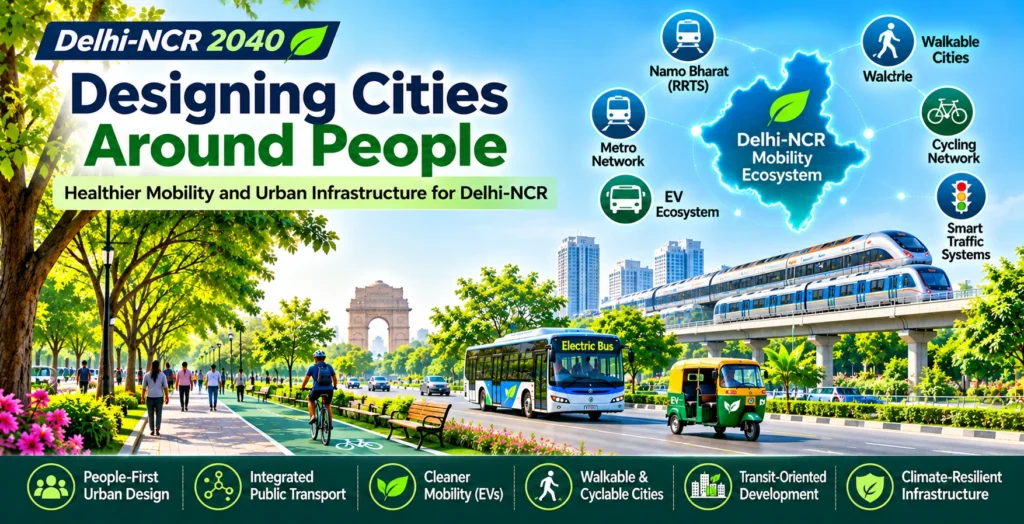
How integrated public transport, electric mobility, intelligent traffic systems, walkable neighbourhoods and climate-resilient infrastructure can make Delhi-NCR a more accessible, cleaner and productive urban region.
Introduction: A smart city should make everyday journeys easier
For millions of people, urban development is experienced through everyday journeys: reaching work, accessing a reliable bus, walking to a Metro station, crossing a road safely and finding affordable last-mile transport.
Delhi-NCR has invested in roads, expressways, Metro infrastructure and regional rail, yet the overall journey remains uneven. A fast train cannot compensate for an unsafe walk to the station or an unreliable feeder service.
The next phase must make the entire journey work—from doorstep to destination. The objective is to move people and goods more efficiently, not simply to move more vehicles.
1. Delhi-NCR’s mobility challenge is regional, not municipal
People live in one city and work, study or access healthcare in another. Journeys between Ghaziabad and Delhi, Noida and Gurugram, Faridabad and South Delhi, or Meerut and Delhi cross administrative boundaries. Routes, fares, permits, roads and services are managed by multiple authorities.
The NCR Planning Board’s transport framework and Draft Regional Plan 2041 recognise regional connectivity, mass transit, Intelligent Transport Systems and coordinated traffic management. The challenge is translating those principles into funded projects, common standards and accountability.
2. Public transport must become the backbone of regional mobility
The NCRPB’s June 2026 update estimated the region’s population at 7.86 crore, projected to reach 14.73 crore by 2041. Private vehicles alone cannot accommodate this growth sustainably.
DMRC’s Annual Report 2024–25 describes an operating network of approximately 394.25 km, 289 stations and 12 lines, including regional connections. Network expansion must be matched by feeder services, safe station access, interchange design, integrated ticketing and passenger information. A Metro station should function as a mobility hub, not an isolated facility.
Namo Bharat and the network-of-networks approach
The 82.15 km Delhi-Ghaziabad-Meerut Namo Bharat corridor became fully operational in February 2026. MoHUA reported more than 3.8 crore passenger journeys by 6 August 2026 and punctuality above 99%, alongside integration with three Metro lines, two railway stations and four bus terminals.
This illustrates the potential of regional rapid transit. Delhi-NCR should progressively integrate Metro, RRTS, city buses, rail services where available, intercity transport, autos, e-rickshaws, walking, cycling and shared mobility.
3. The first and last mile: the biggest weakness in public transport
Missing footpaths, unsafe crossings, unreliable feeder buses, limited e-rickshaw availability, poor lighting and inaccessible stations make public transport inconvenient.
Every major Metro, RRTS and bus interchange should have a planned feeder network: electric feeder buses, e-rickshaws, shared autos, bicycle sharing and safe pedestrian routes.
A regional mobility platform can combine vehicle availability, routes, arrival estimates, fares and disruptions. Measure door-to-door journey time, not only the speed of the main rail journey.
4. Buses: the missing link
Buses serve neighbourhoods, industrial areas, schools, markets and places unsuitable for rail. They need to be reliable, frequent, affordable, accessible and connected to other modes.
PM-eBus Sewa’s national programme portal reported 10,000 buses under the scheme across 115 cities and 26 states/UTs, with more than 1,050 deployed and 28 cities operational as of 13 October 2026. These are national programme figures, not NCR deployment figures.
A separate Payment Security Mechanism supports procurement and operation of more than 38,000 electric buses with an outlay of ₹3,435.33 crore. Electric-bus success depends on depot charging, power connections, route energy planning, maintenance, battery lifecycle and viable contracts. Bus priority lanes and signal priority can improve reliability.
5. Electric mobility: go beyond private electric cars
Prioritise high-utilisation categories: buses, autos, e-rickshaws, delivery two-wheelers, commercial vehicles and municipal fleets.
Delhi’s EV Policy 2026 took effect on 1 July 2026 and covers incentives, charging, electrification and battery recycling. It includes phased provisions for selected vehicle categories and public fleets, including electric new intra-state buses inducted by DTC and the Transport Department, subject to policy provisions and exceptions.
Charging infrastructure should follow travel patterns: depots, residential and commercial areas, logistics hubs, highways and taxi/delivery zones. Publish accurate connector, availability, speed and pricing information.
6. Walkability: the overlooked infrastructure
Broken footpaths, encroachment, unsafe crossings, poor lighting, inadequate shade and inaccessible routes make ordinary journeys difficult, especially for children, older people and people with disabilities.
People-centred streets need continuous footpaths, safe crossings, accessible ramps and tactile surfaces, lighting, traffic calming, shade and safe transit access.
Audit footpath continuity, crossing safety, accessibility, pedestrian injury data, shade and maintenance around stations, schools, hospitals and markets.
7. Cycling and shared mobility
Short trips can often be made by walking, cycling or shared mobility if safe networks exist. Cycling routes must connect homes, jobs, stations, schools and markets; isolated tracks are insufficient.
Provide continuous routes, safe junctions, signage, secure parking, lighting and maintenance. Bicycle-sharing can help, but a convenient app cannot compensate for unsafe streets.
8. Smart traffic management
Congestion wastes time and energy and makes journeys unpredictable. Intelligent Transport Systems combine sensors, cameras, communications and software for adaptive signals, traffic monitoring, incident detection, transit priority, parking management and freight coordination.
Adaptive signals can adjust timings to traffic demand within safety constraints. AI can identify recurring bottlenecks, accident-prone junctions, delays and signal inefficiencies. Systems require reliable data, calibration, human oversight and privacy safeguards.
9. Digital mobility platforms and integrated ticketing
A regional platform should combine Metro/RRTS schedules, bus arrivals, feeder services, shared mobility, walking/cycling directions, fares, disruptions, accessibility, parking and charging availability.
The National Common Mobility Card framework offers a basis for interoperable payments. True integration also needs fare rules, revenue sharing, settlement, refunds, passenger support and consistent service information.
Data governance must define ownership, privacy, security, access and retention; share only what is needed.
10. Urban planning and mobility must work together
Transit-oriented development concentrates suitable housing, employment, services and public spaces around high-capacity transit. Good TOD includes mixed uses, walkable streets, cycling, public spaces, affordable housing options, local services and appropriate parking.
It must be supported by water, drainage, social infrastructure and environmental capacity—not used to justify indiscriminate density.
MoHUA reported TOD zones along the Namo Bharat corridor in Ghaziabad and Meerut master plans and NCRTC Influence Zone Plans for Jangpura and Sarai Kale Khan in August 2026.
11. Freight and logistics
Goods movement is integral to NCR’s economy. A regional freight strategy should consider industrial clusters, warehouses, highway access, terminals, truck parking, delivery windows, loading areas and rail freight opportunities.
Digital platforms can coordinate vehicle location, delivery schedules, route planning, load consolidation, parking and fleet energy. Cleaner last-mile delivery can use suitable electric two- and three-wheelers and light commercial vehicles where viable.
12. Climate-resilient mobility
Extreme heat, intense rainfall, waterlogging and poor visibility disrupt transport. Heat-resilient infrastructure needs shaded pedestrian routes, sheltered bus stops, comfortable stations, drinking water and worker protection.
Flood resilience requires drainage, protection of natural channels, drain maintenance, hotspot mapping, rainfall/water-level monitoring where justified and emergency passenger information. Authorities need procedures for disruption, emergency access, restoration and communication.
13. An integrated mobility intelligence layer
IoT sensors can monitor traffic, parking and road conditions; GPS/telematics can track fleets; AI can support prediction and routing; GIS can identify accessibility gaps; digital twins can test scenarios.
At a Metro/RRTS/bus interchange, a connected system could monitor passenger flows, track feeder availability, identify long waits, adjust feeder allocation, inform passengers and record performance. Start with high-value locations rather than connecting everything at once.
14. What should Delhi-NCR prioritise first?
The following are recommendations, not announced government commitments.
First, fix access to existing transit through footpath audits, safe crossings and feeder services. Second, improve bus frequency, reliability and charging infrastructure. Third, coordinate Metro, RRTS, bus and rail services and ticketing. Fourth, build connected walking and cycling networks. Fifth, improve adaptive traffic management and freight coordination. Sixth, map waterlogging and heat risks and establish resilience protocols.
15. Who should be responsible?
NCRPB: regional planning. NCRTC: Namo Bharat. DMRC: Metro and integration. State transport departments: buses, permits and EV policy. DTC and city operators: bus services. Municipal corporations: local roads, footpaths, crossings and parking. Development authorities: land use and TOD. Traffic police: enforcement and safety. NHAI and road agencies: highways. Railways: rail integration. Technology providers: platforms and analytics. Private operators: feeder/shared mobility. Research institutions: modelling and evaluation.
Coordination should use existing mandates wherever possible.
16. Financing the transformation
Funding can come from central/state urban transport programmes, Metro/RRTS financing, bus schemes, EV-policy incentives, municipal budgets, road-safety programmes, PPPs, TOD mechanisms where appropriate, multilateral finance and private investment in charging.
Evaluate lifecycle costs: buses, batteries, charging, power, maintenance and replacement; or sensors, software, connectivity, calibration and cybersecurity. A low-cost installation that cannot be maintained is not good value.
17. Measuring success
Proposed KPIs—not official targets—include public-transport mode share; population within walking distance of frequent transit; first/last-mile and interchange time; bus frequency and reliability; electrification of eligible fleets; interoperable ticketing; footpath continuity; cycling-network connectivity; pedestrian/cyclist fatalities; journey-time reliability; freight utilisation; weather disruption/recovery; affordability and passenger satisfaction.
Measure complete journeys and report local as well as regional results.
18. Roadmap to 2040
2026–2028
Map coverage and accessibility gaps, audit station access, identify underserved areas, improve feeders, prioritise pedestrian safety, set passenger-information standards and coordinate operators.
Expected result: better use of existing infrastructure.
2028–2032
Expand reliable electric buses, improve interchanges, build connected walking/cycling networks, introduce interoperable ticketing, improve signal coordination and integrate TOD.
Expected result: connected corridors.
2032–2040
Strengthen regional transit, expand integrated coverage, scale data-driven operations, integrate transport and land use, and institutionalise resilience and accessibility.
Expected result: reliable access to jobs, education, healthcare and services.
19. Opportunity for India’s mobility technology ecosystem
Opportunities include ITS, fleet telematics, AI traffic management, integrated mobility platforms, digital ticketing, charging management, public-transport analytics, predictive maintenance, road safety, smart parking, freight optimisation and mobility digital twins.
Affordable fleet tools for smaller operators and accurate feeder-bus passenger information may create more immediate value than complex dashboards. Technology should solve operational problems and demonstrate measurable outcomes.
Conclusion: Build cities around people, not vehicles
The next phase is to make roads, Metro, regional rail and electric mobility work together. Connect the first and last mile, improve buses, create safe pedestrian routes, integrate fares and information, manage traffic intelligently and plan development around public transport.
Mobility is linked to housing, jobs, healthcare, education, climate resilience and productivity. The real test is whether people spend less time travelling, have reliable choices, face fewer safety risks and can access opportunities across the region.
Delhi-NCR 2040 should be a region where mobility is designed around people, connected across cities and measured by the quality of everyday journeys.
What comes next: The Delhi-NCR 2040 series
Read the earlier articles in this series: Delhi-NCR 2040: From Pollution Crisis to a Smarter, Cleaner and More Productive Urban Region (Part 1), Smart Urban Greening: Using Climate Intelligence to Make Delhi-NCR Greener (Part 2) and Cleaner Industry, Stronger Economy: Rethinking Industrial Growth in Delhi-NCR (Part 3).
This is the fourth instalment in our series exploring how Delhi-NCR can turn its environmental and infrastructure challenges into an opportunity for smarter, cleaner and more productive urban growth.
Upcoming articles:
- The Invisible Smart City: Transforming Waste, Water and Energy Infrastructure
How connected utilities, circular resources, smart grids and digital infrastructure can improve efficiency and resilience. - From Smart City Vision to Ground Reality: A 10-Year Transformation Roadmap for Delhi-NCR
Governance, financing, institutional coordination, technology and measurable milestones for delivering the 2040 vision.
References
- NCR Planning Board — Transport Sector
- NCRPB — Draft Regional Plan 2041 policy annexures
- DMRC Annual Report 2024–25
- MoHUA / PIB — Namo Bharat, 6 August 2026
- NCRTC Corporate Folder 2026
- Delhi EV Policy 2026 — Transport Department notifications
- PM-eBus Sewa official portal
- PM-eBus Sewa Payment Security Mechanism — PMO (source could not be automatically verified; URL available on request)
- NCR population / Regional Plan update, 16 June 2026
- National Development Bank — RRTS project evaluation
- NITI Aayog — India Electric Mobility Index 2025
Editorial note: The article distinguishes existing infrastructure and notified policy from recommendations. Proposed KPIs and the 2040 roadmap are IOT News Portal analysis, not official government targets. National PM-eBus Sewa figures are not represented as Delhi-NCR deployment figures.