

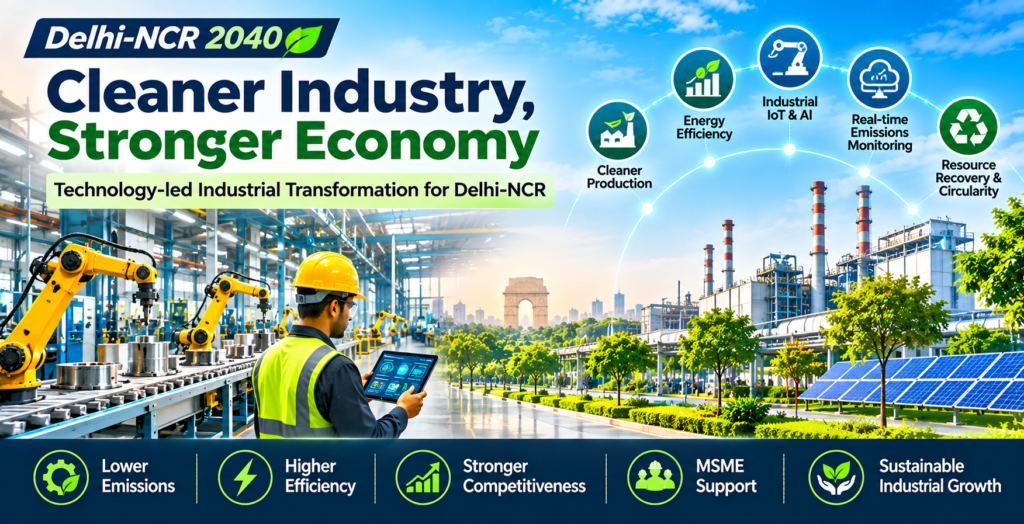
How industrial IoT, cleaner production, energy efficiency and real-time environmental monitoring can help Delhi-NCR protect air quality while strengthening manufacturing, jobs and regional competitiveness.
Introduction: Clean air and economic growth should not be opposing goals
Delhi-NCR needs industry.
Manufacturing creates employment, supports small businesses, attracts investment, generates exports and builds the supply chains that sustain a growing economy. Industrial clusters across Delhi, Haryana and Uttar Pradesh are an important part of the region’s economic ecosystem.
But industrial growth also comes with responsibilities.
Emissions from industrial boilers, furnaces, process operations, diesel generators and other activities contribute to environmental pressures. Industrial wastewater, hazardous waste and inefficient resource consumption create additional challenges.
The debate is often presented as a choice between economic growth and environmental protection.
That is the wrong way to frame the problem.
The real question is:
How can Delhi-NCR retain and expand its industrial capabilities while making production cleaner, more efficient and more competitive?
Closing industrial units indiscriminately or pushing manufacturing out of the region is not a sustainable economic strategy. Nor is allowing industries to operate without meeting environmental standards.
The opportunity lies in transforming industrial operations through better technology, cleaner energy, efficient production processes, transparent monitoring and stronger enforcement.
This is where the next generation of Industrial IoT, automation, artificial intelligence and digital infrastructure can make a meaningful contribution.
The goal should be to move from a model in which pollution is measured after it occurs to one in which industrial processes are designed, monitored and continuously improved to prevent excessive emissions and waste.
For Delhi-NCR, cleaner industry should become a competitive advantage — not merely a regulatory obligation.
1. Why industrial transformation matters to Delhi-NCR
Delhi-NCR is not a single city with a single economic profile. It is a large regional economy with diverse manufacturing and industrial activity.
- The region includes:
- Engineering and metal-processing units.
- Automobile and automotive-component manufacturers.
- Electronics and electrical equipment manufacturers.
- Textiles and garment production.
- Food processing.
- Chemicals and related industries.
- Pharmaceuticals and medical products.
Packaging, plastics and printing.
Construction materials.
Warehousing, logistics and supporting services.
These industries vary considerably in their energy requirements, production processes, environmental footprint and ability to invest in cleaner technology.
A large automobile manufacturer and a small metal-finishing workshop do not face the same technical or financial challenges.
This distinction matters when designing environmental policy.
A uniform compliance expectation may be necessary for a specific pollutant or standard, but the pathway to achieving it can differ according to the industry, process, scale and available technology.
Industrial clusters create both challenges and opportunities
Industrial clusters concentrate production, suppliers, labour, logistics and infrastructure.
This concentration can create environmental pressure when many units use inefficient equipment, polluting fuels or inadequate waste-treatment systems.
But clusters also offer an opportunity.
Instead of expecting every small unit to independently develop expensive environmental infrastructure, authorities and industry associations can explore shared facilities and services.
- Examples include:
- Common effluent treatment plants.
- Shared waste-management infrastructure.
- Common testing and environmental laboratories.
- Cluster-level energy audits.
- Shared renewable-energy procurement.
- Common compressed-air or steam-efficiency programmes where technically viable.
- Digital compliance and reporting services.
The objective should be to improve environmental performance across the industrial ecosystem, not just at individual factory gates.
2. What is the industrial pollution challenge in Delhi-NCR?
Industrial pollution is not one problem. It involves multiple sources and pathways.
A. Combustion emissions
Industrial boilers, furnaces, thermic-fluid heaters and other combustion equipment consume fuel to generate heat.
Depending on the fuel, combustion conditions and pollution-control equipment, they can release particulate matter, sulphur dioxide, nitrogen oxides and other pollutants.
Older or poorly maintained equipment can be particularly inefficient.
Fuel choice is important, but it is not the only factor. Even a cleaner fuel does not eliminate the need for proper combustion management, maintenance and emissions control.
B. Process emissions
- Some industrial processes generate emissions independently of the fuel used.
- Examples include:
- Metal processing and foundries.
- Chemical manufacturing.
- Material handling.
- Surface treatment.
- Industrial drying.
- Processing of mineral and construction materials.
The appropriate control technology depends on the process and the pollutants generated.
C. Diesel generators
Industrial facilities may use diesel generator sets to maintain operations during power interruptions.
The emissions impact depends on generator capacity, operating hours, fuel, maintenance and installed emission-control systems.
Reducing unnecessary DG-set operation and improving the reliability of the electricity supply can therefore contribute to better local air quality.
D. Industrial wastewater
Manufacturing can generate wastewater containing suspended solids, organic matter, chemicals, oils, salts and, in some sectors, heavy metals.
Untreated or inadequately treated discharge can affect drains, rivers and groundwater.
The appropriate treatment system depends on the nature of the wastewater. A treatment solution designed for one industry may not be suitable for another.
E. Solid and hazardous waste
- Industrial processes also generate:
- Sludge.
- Chemical residues.
- Used oils.
- Metal waste.
- Solvents.
- Packaging waste.
- Process by-products.
- Hazardous materials requiring regulated handling.
Poor segregation, storage or disposal can create environmental and occupational risks.
A cleaner industrial strategy must therefore address air, water, waste, energy and resource efficiency together.
3. The regulatory landscape is becoming more demanding
The regulatory environment in Delhi-NCR has moved towards cleaner fuels, stricter emission standards, online monitoring and more active enforcement.
This is an important change for industrial operators.
Environmental compliance is increasingly becoming an operational and technology-management issue rather than a periodic paperwork exercise.
CAQM’s cleaner-fuel transition
The Commission for Air Quality Management (CAQM), in its Annual Report 2024–25, reported that 7,673 of the 7,983 identified fuel-based industries across NCR had shifted to approved fuels.
The remaining 310 industries that could not shift were reported as closed or self-closed by the concerned State Pollution Control Boards and DPCC.
The report also noted that 222 of 240 industrial areas across NCR had PNG infrastructure or connectivity at the time of reporting.
These figures demonstrate the scale of the fuel-transition effort. They should not be interpreted as proof that all industrial emissions have been eliminated or that every connected industrial unit is necessarily using the fuel correctly.
Fuel compliance still requires inspection, monitoring and enforcement.
Stricter particulate-matter standards in 2026
In February 2026, CAQM ctued Statutory Direction No. 98, introducing a particulate-matter emission limit of 50 mg/Nm³ for specified categories of industries operating in Delhi-NCR.
- The identified categories include:
- The 17 categories of highly polluting industries identified by CPCB.
- Red-category medium and large air-polluting industries.
- Food and food-processing units.
- Textile industries with boilers or thermic-fluid heaters.
- Metal industries with furnaces.
- The direction specifies that the standard applies from:
1 August 2026: Large and medium industries.
1 October 2026: Remaining covered industries.
The standard does not override a stricter limit already prescribed for a particular industrial unit.As of November 2026, both implementation dates have passed. Covered industrial units should therefore assess their current compliance against the applicable direction and any stricter conditions attached to their consents or other statutory requirements.
This has practical implications.
Industries may need to review combustion systems, pollution-control equipment, operating practices, maintenance arrangements and emissions-monitoring systems.
Simply purchasing new equipment is not enough. The equipment must be correctly sized, installed, operated, calibrated and maintained.
4. Real-time emissions monitoring: moving from periodic checks to continuous visibility
One of the most important technology developments in industrial environmental management is the use of Online Continuous Emission Monitoring Systems (OCEMS).
These systems measure selected pollutants at industrial sources and transmit data to regulatory authorities.
They can provide a continuous stream of information rather than relying exclusively on occasional inspections and manual sampling.
How OCEMS works
- A typical system can include:
- Sampling probes installed at an appropriate emissions point.
- Gas or particulate analysers.
- Sample conditioning and supporting equipment.
- Calibration and quality-control arrangements.
- Data acquisition and transmission systems.
- Connectivity to regulatory servers.
Software for reviewing, validating and reporting readings.
Depending on the installation, the system may monitor parameters such as particulate matter, sulphur dioxide, nitrogen oxides and other specified pollutants.
The exact parameters depend on the industrial process and applicable regulatory requirements.
What the latest NCR monitoring figures show
A Ministry of Environment, Forest and Climate Change update published on 8 February 2026 reported the following OCEMS installation or purchase-order status:
| NCR region | Industries required to install OCEMS | Installation / purchase-order status |
|---|---|---|
| Delhi | 128 | 57 |
| Haryana NCR | 907 | 905 |
| Rajasthan NCR | 255 | 145 |
| Uttar Pradesh NCR | 648 | 320 |
| Total | 1,938 | 1,427 |
The same update reported that CAQM’s dedicated OCEMS Cell had verified installations in 865 industries, recommended notices in 530 cases and carried out field verifications in 122 cases.
These are different measures and should not be treated as interchangeable. In particular, an installation or purchase order does not necessarily mean that a system is fully operational, calibrated and transmitting reliable data.
The real issue: data quality
- Installing an analyser is only the beginning.
- An OCEMS system can become ineffective if:
- Instruments are incorrectly selected for the emissions stream.
- Sampling arrangements are poorly designed.
- Calibration is neglected.
- Maintenance is delayed.
- Data transmission is interrupted.
- Readings are manipulated or misinterpreted.
- Abnormal readings are not investigated.
CPCB’s technical guidance for continuous emissions monitoring addresses installation, calibration, operation, data generation and transmission.
It also emphasises that continuous monitoring should support both regulatory compliance and in-house process optimisation.
The next step should be to treat emissions data as an operational input, not merely a regulatory reporting requirement.
5. Industrial IoT: make cleaner production part of everyday operations
The strongest opportunity for Industrial IoT is not limited to monitoring pollution at the factory boundary.
It is to identify and reduce the operational inefficiencies that create unnecessary energy consumption, material waste and emissions in the first place.
An industrial facility already generates large amounts of operational data.
Machines, motors, compressors, boilers, furnaces, pumps, production lines and utility systems can provide information about their performance.
Industrial IoT connects these systems, collects data and makes it useful for operational decisions.
A. Smart energy management
- Energy is a major operating cost for many manufacturing businesses.
- Industrial energy-management systems can monitor:
- Electricity consumption.
- Fuel consumption.
- Energy use by production line.
- Peak demand.
- Power factor.
- Equipment operating hours.
- Energy consumed per unit of production.
- This enables management to identify where energy is being wasted.
For example, a manufacturing unit may discover that its compressed-air system consumes substantial electricity even when production demand is low.
Monitoring pressure, leakage, compressor loading and operating schedules can help reduce unnecessary consumption.
B. Predictive maintenance
Equipment degradation can increase energy consumption and reduce production efficiency.
Vibration, temperature, pressure and current sensors can provide early indications of abnormal equipment behaviour.
- Predictive-maintenance systems can help identify:
- Motor-bearing deterioration.
- Pump performance degradation.
- Compressor inefficiency.
- Furnace temperature instability.
- Abnormal equipment vibration.
- Excessive energy consumption.
This can reduce unplanned downtime and prevent equipment from operating inefficiently for extended periods.
C. Process optimisation
Industrial processes often operate with parameters such as temperature, pressure, flow rate, speed and feed composition.
Even small improvements can have significant effects when repeated across thousands of operating hours.
Connected control systems can help maintain process conditions within suitable operating ranges.
- Examples include:
- Optimising furnace combustion.
- Controlling boiler air-to-fuel ratios.
- Reducing unnecessary heating and cooling.
- Improving material handling.
- Reducing process rejects.
- Optimising industrial drying.
- Monitoring steam and compressed-air losses.
- The goal is to produce the same or better output with fewer resources.
D. Digital production visibility
A connected production system can link manufacturing execution, equipment data, quality information and utility consumption.
This helps managers understand the relationship between production output and environmental performance.
For example:
If energy consumption increases while production output remains constant, the system can flag a potential efficiency problem.
If a particular production batch generates unusually high process waste, the data can help identify the relevant machine, material or operating condition.
This is where industrial intelligence becomes commercially valuable.
6. AI in manufacturing: from monitoring to optimisation
Industrial AI can add value when it is applied to specific operational problems and trained on reliable plant data.
It should not be introduced simply because AI is attracting attention.
Practical applications
1. Predictive maintenance
AI models can analyse historical equipment data to identify patterns associated with equipment failure.
2. Energy optimisation
Models can examine energy consumption, production schedules, weather conditions and equipment performance to identify opportunities for reducing energy use.
3. Process control
AI-assisted systems can recommend or, where safely authorised, adjust operating parameters to improve process stability.
4. Quality control
Computer vision can detect defects and reduce material rejection and rework.
5. Emissions anomaly detection
Analytics can identify unusual emissions patterns, sudden changes or sensor readings that require investigation.
6. Production planning
AI can help coordinate machine schedules, production loads and maintenance windows to reduce avoidable energy consumption.
A practical example: a metal-processing unit
Consider a metal-processing facility operating several furnaces.
A conventional operating model may depend heavily on manual readings, periodic inspections and operator experience.
- A connected model could combine:
- Furnace temperature sensors.
- Fuel-flow meters.
- Oxygen measurements.
- Stack-emission monitoring.
- Production data.
- Equipment-maintenance records.
An analytics system could compare fuel consumption and emissions against production output.
If fuel use rises without a corresponding increase in output, the system could flag possible combustion inefficiency or equipment degradation.
If emissions exceed an expected operating range, the system could alert the plant team to investigate.
The result is not an automatic guarantee of compliance. It is better visibility, faster intervention and a stronger basis for process improvement.
7. Cleaner energy and energy efficiency: the economics of industrial transformation
Cleaner industrial production is not only about reducing pollution.
Energy efficiency can directly improve operating economics.
A factory that uses less electricity or fuel for the same output can reduce its energy costs, improve margins and become less exposed to energy-price volatility.
The Perform, Achieve and Trade framework
India’s Perform, Achieve and Trade (PAT) scheme has been an important mechanism for improving energy efficiency in energy-intensive industries.
The scheme used specific energy-consumption targets and a market-based mechanism through Energy Saving Certificates.
However, India’s industrial energy-policy framework has been evolving.
In December 2025, the Government of India described the transition of several major energy-intensive sectors — including aluminium, cement, petrochemicals, refineries, pulp and paper, textiles and chlor-alkali — from the earlier PAT mechanism to the compliance mechanism under the Carbon Credit Trading Scheme (CCTS).
Under CCTS, covered entities receive greenhouse-gas emission-intensity targets. Entities that outperform applicable targets can earn Carbon Credit Certificates under the scheme’s rules.
The transition is important because it connects industrial performance more directly with greenhouse-gas emissions intensity rather than only energy consumption.
The exact obligations and coverage should be checked against the current notifications and rules applicable to each sector and entity.
ADEETIE: supporting MSME energy efficiency
Large companies may have dedicated engineering teams and capital budgets for energy-efficiency projects.
Smaller manufacturers often face a different challenge: they may know that their equipment is inefficient but lack the capital or technical capacity to upgrade it.
The Ministry of Power launched the Assistance in Deploying Energy Efficient Technologies in Industries & Establishments (ADEETIE) scheme in July 2025.
The scheme has a stated outlay of ₹1,000 crore and is implemented by the Bureau of Energy Efficiency.
Its purpose is to support MSMEs in adopting energy-efficient technologies through technical assistance and financial support, including interest subsidies.
The BEE describes the programme as operational across 60 industrial clusters in 14 energy-intensive sectors. Eligibility and implementation details should be checked before an enterprise assumes that a particular project or location qualifies.
For Delhi-NCR’s MSME ecosystem, schemes of this nature can help address the financing barrier to cleaner production.
8. Industrial water management: reduce consumption, treat and reuse
Industrial transformation must extend beyond air emissions.
Water availability and wastewater management are important considerations for a region that already faces water stress.
Many industrial processes require water for cooling, washing, processing, cleaning and other operations.
- A more efficient industrial water strategy should focus on three stages:
- Reduce freshwater consumption.
- Treat wastewater to the required standard.
- Reuse treated water wherever technically and legally appropriate.
Common Effluent Treatment Plants
Common Effluent Treatment Plants (CETPs) can provide shared wastewater-treatment infrastructure for industrial clusters.
They are particularly relevant where individual small and medium-sized units may not be able to operate sophisticated treatment systems independently.
Delhi’s Department of Industries documents 13 CETPs serving approved industrial areas, with a combined treatment capacity of 212.3 million litres per day.
The department also reports that online monitoring systems have been installed at these CETPs to measure parameters including pH, total suspended solids, biochemical oxygen demand and chemical oxygen demand at their outlets, with connectivity to DPCC and CPCB servers.
This provides an example of how shared infrastructure and digital monitoring can work together.
Where IoT can help
- Connected water-management systems can monitor:
- Freshwater intake.
- Process-water consumption.
- Wastewater flow.
- pH.
- Conductivity.
- Temperature.
- Treatment-system operating conditions.
- Treated-water quality parameters.
The purpose is to detect abnormal consumption, treatment failures and potential discharge problems earlier.
However, sensors do not replace laboratory testing, prescribed sampling, calibration or statutory compliance requirements.
Industrial water reuse
- Treated wastewater may be reused for suitable applications such as:
- Cooling systems.
- Cleaning.
- Gardening and landscaping.
- Flushing.
- Other non-potable industrial processes.
- The quality requirement depends on the intended reuse.
A reuse system should therefore be designed around the actual application rather than assuming that all treated wastewater is suitable for every purpose.
9. Industrial symbiosis: turn one industry’s waste into another’s resource
One of the most promising opportunities in industrial clusters is industrial symbiosis.
This is the practice of identifying opportunities for one industrial facility’s by-products, residual heat, water or waste materials to become useful inputs for another facility.
Instead of treating every waste stream as an isolated disposal problem, cluster-level planning can explore whether certain materials can be recovered and reused safely.
- Potential examples include:
- Reusing suitable process heat.
- Recovering and reusing treated water.
- Recycling metal residues.
- Recovering selected solvents.
- Using suitable industrial by-products in other manufacturing processes.
- Sharing waste-treatment and resource-recovery infrastructure.
Such exchanges require careful technical, environmental and regulatory assessment.
A material cannot be treated as a useful resource merely because another company is willing to receive it. Its composition, safety, quality, transport and applicable waste-management rules must be considered.
How digital platforms can enable this
- An industrial-cluster resource platform could maintain information about:
- Waste and by-product types.
- Material quantity and quality.
- Availability and generation schedules.
- Potential receiving industries.
- Transportation requirements.
- Regulatory classification.
- Treatment and processing needs.
- AI-based matching could help identify potential exchanges.
The platform would not replace environmental approvals or commercial agreements. It would help industries discover opportunities that might otherwise remain invisible.
10. Cleaner production should not become an MSME survival problem
A transition that only large companies can afford will leave a significant part of the industrial ecosystem behind.
Small and medium-sized manufacturers often operate with limited margins, older machinery, constrained working capital and limited access to specialist engineering expertise.
Their environmental transition must be commercially realistic.
The challenges facing MSMEs
- High upfront cost of modern equipment.
- Difficulty obtaining affordable finance.
- Limited technical expertise.
- Lack of reliable energy and environmental audits.
- Limited access to qualified technology providers.
- Uncertainty about payback periods.
- Difficulty navigating multiple regulatory requirements.
These barriers should not be used as reasons to avoid compliance. They should be addressed through better support mechanisms.
A cluster-based support model
A practical model could include:
1. Shared energy audits
Industrial associations can coordinate energy audits and identify common inefficiencies across member units.
2. Technology demonstration centres
Demonstration facilities can allow MSMEs to evaluate energy-efficient motors, compressors, boilers, furnaces, sensors and control systems before making investments.
3. Common technical services
Clusters can share access to qualified environmental engineers, energy auditors, testing facilities and calibration services.
4. Financing support
Eligible MSMEs should be helped to understand and access schemes such as ADEETIE and relevant state or financial-institution programmes.
5. Standard technology packages
For recurring applications, industry associations and technology providers can develop validated, application-specific upgrade packages.
6. Digital compliance assistance
Simple platforms can help smaller units maintain records, schedule inspections, track calibration and manage required reporting.
The aim should be to make compliance easier to achieve without weakening the standards themselves.
11. Industrial clusters as smart manufacturing ecosystems
The next opportunity is to think beyond individual smart factories.
A smart industrial cluster could combine shared digital infrastructure, environmental monitoring, resource management and common services.
What would such a cluster look like?
- A cluster-level platform could integrate:
- Industrial energy data.
- Air-emissions monitoring where authorised.
- Wastewater-treatment performance.
- Water consumption.
- Common waste-management records.
- Renewable-energy generation and consumption.
- Shared utility infrastructure.
- Environmental inspection and compliance records.
- Emergency and incident reporting.
- Different users would have different levels of access.
An individual factory would access its own operational information. A CETP operator would manage treatment-related information. Regulators would access information according to their statutory authority. Cluster associations could use aggregated, non-confidential information to identify shared improvement opportunities.
Why this matters
A cluster platform could help answer questions that are difficult to address using isolated factory-level data:
- Which industrial areas have the greatest energy-efficiency opportunities?
- Where is water consumption rising?
- Which common treatment facilities need capacity upgrades?
- Which industrial units require technical support?
- Where are environmental incidents recurring?
- Which shared infrastructure investments could benefit several businesses?
- This creates a more coordinated approach to industrial development.
It also provides a foundation for better public accountability, provided data quality, access controls and governance are properly designed.
12. International examples: what can Delhi-NCR learn?
International experience demonstrates that cleaner industry and economic competitiveness can reinforce each other.
The examples below illustrate different approaches rather than providing templates that Delhi-NCR can copy directly.
Germany: energy efficiency and industrial competitiveness
Germany’s industrial ecosystem has placed substantial emphasis on energy efficiency, advanced manufacturing, automation and resource productivity.
Its experience demonstrates the importance of treating energy and material efficiency as core manufacturing capabilities rather than separate environmental projects.
What Delhi-NCR can learn: industrial efficiency programmes should be linked to productivity, equipment modernisation, technical skills and competitiveness.
Singapore: integrated industrial planning
Singapore’s industrial development approach combines infrastructure planning, technology adoption, environmental management and efficient land use.
Its industrial estates demonstrate the value of planning utilities and shared infrastructure at the estate level.
What Delhi-NCR can learn: industrial clusters can be planned as integrated systems with shared utilities, resource management and coordinated environmental infrastructure.
China: industrial digitalisation
China has invested heavily in industrial automation, connected manufacturing and digital production systems.
The broader lesson is that manufacturing competitiveness increasingly depends on the ability to use operational data to improve quality, productivity, maintenance and resource efficiency.
What Delhi-NCR can learn: digital manufacturing should be treated as an economic-modernisation agenda, with practical adoption pathways for both large enterprises and MSMEs.
Kalundborg, Denmark: industrial symbiosis
The Kalundborg Symbiosis is a recognised example of industrial companies and public utilities exchanging resources and by-products through established commercial relationships.
The model illustrates how industrial ecosystems can identify value in material, water and energy flows that might otherwise be wasted.
What Delhi-NCR can learn: industrial associations and authorities can map resource flows across clusters and identify safe, commercially viable opportunities for shared infrastructure and industrial symbiosis.
These examples should be adapted to NCR’s own industrial structure, water availability, regulatory framework and financing capacity.
13. The proposed Delhi-NCR Clean Industry Transformation Programme
The following is a proposal from IOT News Portal. It is not an announced government programme.
The aim is to connect existing regulatory mechanisms, industrial infrastructure, technology adoption and financing into a practical regional framework.
Pillar 1: Establish an industrial environmental baseline
- Create a verified baseline for major industrial clusters.
- It should include:
- Industrial categories and production profiles.
- Fuel consumption and energy intensity.
- Emissions-monitoring status.
- Applicable emission standards.
- Wastewater generation and treatment.
- Water consumption.
- Solid and hazardous waste.
- Existing pollution-control equipment.
- Technology and financing gaps.
The baseline should distinguish verified information from estimates and self-reported data.
Pillar 2: Accelerate cleaner production
- Support industrial units in identifying and implementing:
- Cleaner and approved fuels.
- Efficient boilers and furnaces.
- High-efficiency motors and drives.
- Optimised compressed-air systems.
- Waste-heat recovery where viable.
- Process automation.
- Efficient cooling and pumping.
- Better material utilisation.
- Suitable renewable-energy integration.
Pillar 3: Strengthen digital environmental monitoring
- Improve the reliability and use of OCEMS and online effluent monitoring.
- The focus should be on:
- Correct installation.
- Calibration.
- Maintenance.
- Data validation.
- Connectivity.
- Independent verification.
- Timely regulatory action.
Pillar 4: Build cluster-level shared infrastructure
- Identify opportunities for:
- CETP upgrades.
- Common hazardous-waste services.
- Shared testing facilities.
- Resource recovery.
- Water reuse.
- Renewable-energy infrastructure.
- Technical support centres.
Pillar 5: Make MSME modernisation affordable
- Connect industrial units with:
- Energy audits.
- Technical advisory services.
- Demonstration facilities.
- Eligible financial incentives.
- Equipment-financing options.
- Cluster-based technology procurement.
Pillar 6: Create a regional industrial intelligence platform
Develop a secure data framework that can connect environmental performance, energy efficiency and industrial infrastructure information.
It should support operational decisions and regulatory oversight without unnecessarily exposing commercially sensitive factory information.
14. Who should lead the transformation?
Delhi-NCR already has institutions responsible for industrial development, environmental regulation, energy efficiency and infrastructure.
The objective should be better coordination between them rather than automatically creating another authority.
| Institution / stakeholder | Potential role |
|---|---|
| CAQM | Regional air-quality directions, industrial emission standards and coordination |
| CPCB | Technical guidance, monitoring frameworks and national environmental standards |
| DPCC and NCR State Pollution Control Boards | Consent, inspections, monitoring, enforcement and environmental compliance |
| Ministry of Environment, Forest and Climate Change | Environmental policy and regulatory framework |
| Bureau of Energy Efficiency | Industrial energy-efficiency programmes and technical support |
| Ministry of Power | Energy-efficiency policy and industrial energy initiatives |
| State industry departments | Industrial policy, cluster infrastructure and investment facilitation |
| Industrial development authorities | Industrial-estate planning and common infrastructure |
| Industrial associations | Cluster-level participation, shared services and MSME coordination |
| Technology companies | Industrial IoT, automation, analytics, sensors and digital platforms |
| Banks and financial institutions | Financing of eligible cleaner-production investments |
| Research and technical institutions | Audits, testing, technology validation and independent evaluation |
A practical first step would be to identify existing coordination forums and define a shared work programme for selected industrial clusters.
Each initiative should have an identified implementing agency, budget, timeline and performance indicator.
15. Financing the transition: compliance, productivity and investment
Cleaner industrial production requires investment.
But it is important to distinguish between expenditure that simply meets a regulatory requirement and investment that also improves operational productivity.
A well-designed upgrade can potentially deliver both.
Possible financing channels
- Existing BEE energy-efficiency programmes.
- ADEETIE support for eligible MSMEs.
- Bank and non-bank equipment finance.
- State industrial-development programmes.
- Renewable-energy financing.
- Energy-service-company models where commercially suitable.
- Corporate investment by large manufacturers.
- Cluster-level infrastructure financing.
- Relevant central and state environmental programmes.
Evaluate projects using operational economics
Industrial units should evaluate cleaner-production projects using measurable business indicators:
- Energy saved per unit of output.
- Fuel saved per production cycle.
- Reduction in equipment downtime.
- Reduction in material rejection.
- Reduction in water consumption.
- Reduction in waste-treatment cost.
- Maintenance-cost changes.
- Compliance-related operating costs.
- Total cost of ownership.
Payback periods should be calculated using actual site data rather than generic claims from equipment suppliers.
The case for investment
- A factory that reduces energy intensity may improve its margins.
- A manufacturer that reduces defects may use less raw material.
- A facility that recovers process heat may reduce fuel consumption.
A company with reliable environmental data may be better prepared for customer audits and supply-chain requirements.
The business case will vary by sector, but the direction is clear: environmental performance and operational efficiency should be considered together.
16. How should Delhi-NCR measure success?
A cleaner-industry programme should not be evaluated only by the number of inspections, sensors or equipment installations.
It should measure whether industrial operations are actually becoming cleaner and more efficient.
The following are proposed indicators, not existing official targets.
| Area | Proposed KPI |
|---|---|
| Air emissions | Compliance with applicable pollutant-specific emission standards |
| Monitoring | Percentage of required OCEMS installations operational, calibrated and data-validated |
| Enforcement | Time taken to investigate and resolve verified exceedances |
| Energy | Energy consumed per unit of production |
| Fuel | Fuel consumption and approved-fuel compliance |
| Water | Freshwater consumed per unit of production |
| Wastewater | Percentage of wastewater treated and reused where suitable |
| Waste | Quantity of waste recovered, recycled or safely managed |
| MSME adoption | Number of MSMEs completing verified efficiency upgrades |
| Productivity | Change in production yield, rejects and downtime |
| Investment | Capital deployed in cleaner-production improvements |
| Cluster infrastructure | Performance and utilisation of common treatment and resource facilities |
Two principles are important.
First, data should be measured at the facility or cluster level, with appropriate aggregation for public reporting.
Second, environmental improvement should not be inferred from technology deployment alone.
Installing an emissions analyser does not prove that emissions have fallen. Installing an efficient motor does not prove that the factory’s energy intensity has improved.
Performance must be measured against a credible baseline.
17. A practical roadmap to 2040
Industrial transformation should be phased according to regulatory priorities, technology readiness, financing and the needs of individual clusters.
Phase 1: Establish the baseline and close urgent gaps (2026–2028)
- Verify compliance with the applicable CAQM particulate-matter standards.
- Complete required OCEMS installation and operational verification.
- Identify units requiring pollution-control upgrades.
- Conduct energy and water audits in priority clusters.
- Map common treatment and waste-management infrastructure.
- Identify MSMEs eligible for relevant energy-efficiency support.
- Establish pilot digital monitoring and industrial-efficiency projects.
Expected result: Better compliance visibility, identified investment needs and a practical baseline for industrial performance.
Phase 2: Modernise priority industrial clusters (2028–2032)
Expand industrial energy-management systems.
Support efficient boilers, furnaces, motors and compressors.
- Improve common effluent-treatment infrastructure.
- Introduce cluster-level digital monitoring where justified.
- Expand treated-water reuse.
- Develop shared technical and testing services.
- Support industrial symbiosis pilots.
- Publish periodic cluster-level performance reports.
Expected result: Measurable improvements in industrial energy intensity, resource efficiency and environmental compliance.
Phase 3: Build a competitive clean-industrial region (2032–2040)
- Integrate cleaner production into industrial estate planning.
- Expand advanced manufacturing and automation.
- Scale resource recovery and industrial symbiosis where viable.
- Strengthen low-carbon energy procurement and efficiency.
- Use AI and digital systems for continuous process optimisation.
Make environmental performance a regular component of industrial investment and management decisions.
Expected result: Delhi-NCR develops a more productive, resource-efficient and environmentally accountable industrial ecosystem.
18. The opportunity for India’s industrial technology sector
This transformation can also create opportunities for Indian technology companies.
- The demand is not limited to pollution-monitoring equipment.
- Industrial modernisation can create opportunities across:
- Industrial IoT platforms.
- Smart sensors and instrumentation.
- Process automation.
- Industrial AI.
- Energy-management software.
- Predictive maintenance.
- Continuous emissions monitoring.
- Water-quality monitoring.
- Industrial cybersecurity.
- Digital twins.
- Waste and resource-management platforms.
- Industrial analytics and reporting.
Indian startups and established engineering companies can develop solutions tailored to the operating realities of local industrial clusters.
There is particular opportunity in solutions designed for MSMEs.
Large industrial enterprises may already have sophisticated automation systems. Smaller factories often need affordable, modular and easy-to-maintain solutions that can demonstrate measurable returns.
Technology providers should therefore focus on specific industrial problems rather than selling broad digital-transformation promises.
- A useful solution should answer at least one of these questions:
- Does it reduce energy consumption?
- Does it improve process yield?
- Does it reduce equipment downtime?
- Does it improve environmental compliance?
- Does it reduce water or material waste?
- Does it make maintenance more predictable?
Does it provide reliable, auditable information?
If it cannot demonstrate operational value, it is unlikely to achieve sustained adoption.
Conclusion: Make clean manufacturing a competitive advantage
Delhi-NCR should not have to choose between industrial development and environmental responsibility.
The region needs manufacturing, jobs, investment and innovation. It also needs cleaner air, better water management and responsible use of natural resources.
The way forward is to modernise industrial production.
Cleaner fuels, efficient equipment, process optimisation, real-time monitoring, better wastewater treatment, resource recovery and industrial IoT can all contribute.
But technology alone will not deliver the transformation.
It must be supported by clear regulations, reliable infrastructure, affordable financing, capable technical teams, credible data and consistent enforcement.
Large manufacturers should be expected to invest in cleaner operations. MSMEs should have access to practical technical and financial support. Industrial associations should help coordinate shared infrastructure. Regulators should use reliable monitoring data to enforce standards fairly and consistently.
The objective should be an industrial ecosystem where environmental compliance is built into everyday operations, not treated as a seasonal exercise.
A cleaner industrial region can also be a more efficient, productive and competitive industrial region.
That is the opportunity Delhi-NCR should pursue on its path to 2040.
What comes next: The Delhi-NCR 2040 series
Read the earlier articles in this series: Delhi-NCR 2040: From Pollution Crisis to a Smarter, Cleaner and More Productive Urban Region (Part 1) and Smart Urban Greening: Using Climate Intelligence to Make Delhi-NCR Greener (Part 2).
This is the third installment in our series exploring how Delhi-NCR can turn its environmental challenges into an opportunity for smarter, cleaner and more productive urban growth.
Upcoming articles:
- Designing Cities Around People: Healthier Mobility and Urban Infrastructure
How public transport, electric mobility, walkability, shaded streets and climate-resilient public infrastructure can improve urban life. - The Invisible Smart City: Transforming Waste, Water and Energy Infrastructure
How connected utilities, circular resource systems and smart infrastructure can improve efficiency and resilience. - From Smart City Vision to Ground Reality: A 10-Year Transformation Roadmap for Delhi-NCR
Governance, financing, institutional coordination, technology and measurable milestones for delivering the 2040 vision.