
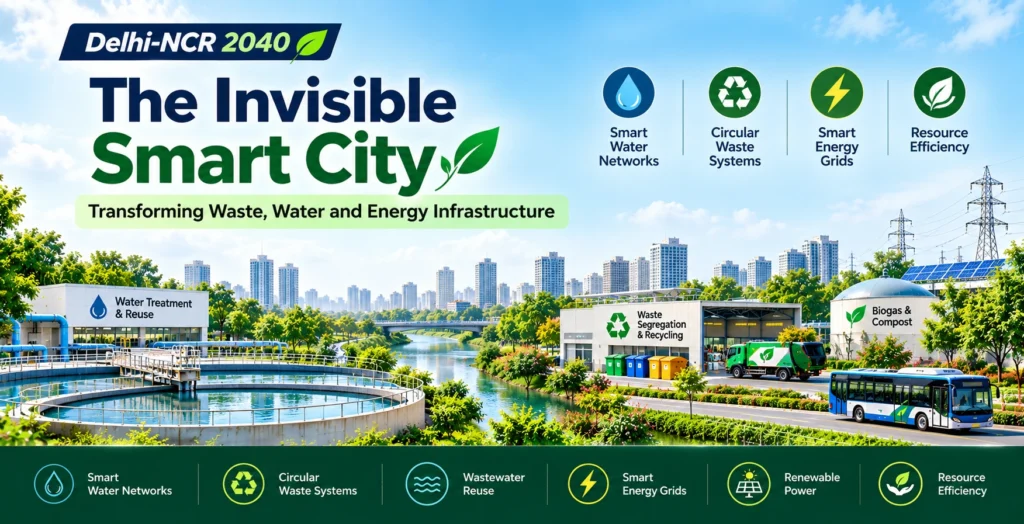
How connected utilities, circular resource systems, wastewater reuse, smart grids and renewable energy can make Delhi-NCR more resilient, efficient and sustainable by 2040.
Introduction: The infrastructure that determines whether a city really works
A city is often judged by what people can see.
Its roads, Metro stations, airports, commercial districts, parks and high-rise buildings become symbols of progress. But the quality of urban life depends just as much on infrastructure that remains largely invisible.
The water that reaches a household. The sewage that leaves it. The waste collected from its streets. The electricity that powers its homes and businesses. The drainage system that protects it during heavy rainfall.
These systems determine whether a city can function reliably as its population grows.
Delhi-NCR faces a particularly complex challenge. It is a large and economically important urban region, but its water resources are constrained, its waste-management systems are under pressure, its rivers and drains face pollution loads, and its electricity infrastructure must support growing demand alongside the transition to cleaner energy.
These challenges are connected.
Poor waste management can contaminate land and water. Untreated sewage affects rivers and groundwater. Water pumping and treatment consume electricity. Electricity distribution losses increase costs and resource requirements. Unplanned urban expansion makes all these systems more expensive to operate.
Addressing each problem independently will not be enough.
Delhi-NCR needs to move from managing utilities as separate services to managing water, waste and energy as an interconnected urban resource system.
This is where IoT, AI, smart meters, GIS, digital twins, automation and data-driven operations can make a practical difference.
But technology is not the objective. The objective is reliable services, reduced resource losses, cleaner surroundings, lower operating costs and greater resilience.
1. Why utilities must become a regional priority
The National Capital Region is not a single municipal entity. It spans multiple states, cities, towns, industrial clusters and rural settlements.
Water supply, sewerage, waste collection, electricity distribution and drainage are managed by different institutions. Their operational boundaries do not always match the way resources move through the region.
For example:
- Water may be sourced outside a municipality and distributed across several urban areas.
- Waste generated in one locality may be transported to a processing facility elsewhere.
- Sewage from a growing settlement may enter a drainage system that eventually affects a river beyond its municipal boundary.
- Electricity demand in one urban cluster may depend on generation, transmission and distribution infrastructure spread across several jurisdictions.
The NCR Planning Board’s regional water-sector framework has long recognised that water resources in the region are inadequate to meet demand comfortably, particularly during summer. It identifies integrated regional water planning, groundwater recharge, protection of recharge areas and wastewater reuse as important strategies.
The Draft Regional Plan 2041’s smart-infrastructure annexures also identify practical applications such as sensor-based leakage detection, remote monitoring of water networks, smart irrigation and consumption tracking.
These are not futuristic concepts. They are operational tools that can be deployed today, provided that institutions have the capacity to act on the information.
The region’s challenge is to connect planning, infrastructure investment, service delivery and accountability.
2. Water security: treat every drop as an economic resource
Water security is one of the most important long-term infrastructure challenges for Delhi-NCR.
The region’s demand is driven by population growth, residential development, commercial activity, manufacturing, construction, agriculture and public infrastructure.
Freshwater availability is constrained by geography, seasonal variation, dependence on external sources, groundwater stress and distribution inefficiencies.
The conventional approach has largely focused on increasing supply.
That remains important, but supply augmentation alone cannot provide a durable solution.
A more resilient water system must combine:
- Reliable source management.
- Efficient treatment and distribution.
- Reduction of physical and commercial losses.
- Groundwater recharge and conservation.
- Wastewater treatment and reuse.
- Demand management.
- Real-time monitoring and operational accountability.
2.1 Reduce losses before building more supply infrastructure
Water lost through leaking pipes, faulty connections, overflowing reservoirs and inaccurate metering represents both a resource loss and a financial cost.
Many urban water networks contain infrastructure installed over several decades. Their condition and performance can vary considerably between localities.
A modern water utility should know:
- How much water enters each distribution zone.
- How much is delivered to consumers.
- Where pressure is abnormal.
- Where leakage is suspected.
- Which pipelines experience repeated failures.
- Which areas face intermittent supply.
- How consumption changes by season and time of day.
This is the foundation of a data-driven water distribution network.
2.2 The role of IoT in water management
IoT-based water-management systems can use:
- Smart water meters.
- Pressure sensors.
- Flow meters.
- Reservoir-level sensors.
- Pump-performance monitoring.
- Acoustic leak-detection systems.
- Water-quality monitoring equipment.
- Remote telemetry and control systems.
For example, if a distribution zone receives substantially more water than its metered consumption indicates, the utility can investigate possible leakage, unauthorised connections or metering problems.
Pressure sensors can help identify abnormal changes that may indicate a burst pipeline or a developing fault.
Smart meters can also help utilities identify unusual consumption patterns and improve billing accuracy.
However, installing sensors does not automatically reduce losses. The utility needs trained teams, maintenance budgets, repair procedures and operational authority to respond to alerts.
The real value of smart water infrastructure is not the data it collects. It is the loss it helps prevent.
2.3 Create water-management zones
Delhi-NCR’s water utilities should progressively develop measurable distribution zones.
Each zone should have defined:
- Water input.
- Consumer demand.
- Metering coverage.
- Estimated leakage.
- Supply hours.
- Pressure standards.
- Quality indicators.
- Repair response time.
This would allow utilities to compare performance and prioritise investment.
Instead of replacing pipelines across an entire city without a clear performance baseline, authorities could identify the zones where intervention offers the greatest benefit.
3. Wastewater: turn a disposal problem into a second water supply
Wastewater is often treated as something that must be removed from a city.
That is an outdated approach for a water-stressed region.
Domestic, commercial and industrial wastewater can become a useful resource if it is collected, treated to appropriate standards, monitored and reused for suitable purposes.
Potential uses include:
- Industrial cooling and process requirements.
- Construction activities.
- Landscaping and horticulture.
- Road cleaning.
- Toilet flushing through suitable dual-piping systems.
- Certain agricultural applications, subject to quality and health safeguards.
- Other non-potable municipal uses.
The important principle is that treated wastewater should be used according to its quality and intended application.
Not all treated water is suitable for every purpose.
3.1 Delhi’s sewage-treatment challenge
A Ministry of Jal Shakti reply published by the Press Information Bureau on 31 July 2025 reported the following Delhi figures:
| Indicator | Reported figure |
|---|---|
| Estimated sewage generation | 3,596 MLD |
| Installed capacity of 37 operational STPs | 3,474 MLD |
| Capacity utilisation as of June 2025 | 2,955 MLD |
| Treated sewage reported compliant with DPCC standards | 2,014 MLD |
| STPs reported non-compliant with DPCC norms | 14 |
| Sewage reported untreated and entering rivers or drains | Approximately 641 MLD |
These figures are a useful illustration of the difference between installed treatment capacity and effective treatment performance.
A city can have substantial installed infrastructure and still face a serious pollution problem if plants are underperforming, sewage does not reach them, or treated output does not consistently meet required standards.
The data also highlights why infrastructure capacity alone is an inadequate measure of success.
The region needs to measure actual sewage collected, actual volume treated, treatment quality, compliance, and the quantity safely reused.
3.2 Move from treatment capacity to treatment outcomes
A more effective wastewater-management system should monitor the complete chain:
- Sewage generation.
- Collection-network coverage.
- Pumping-station performance.
- Treatment-plant inflow.
- Treatment efficiency.
- Compliance with discharge standards.
- Quantity reused.
- Final discharge and environmental impact.
IoT sensors and online monitoring can support measurement of flow, pH, dissolved oxygen, turbidity and other relevant parameters.
The exact monitoring requirements should depend on the plant, process and applicable regulatory standards.
Automated monitoring can improve visibility, but independent sampling, calibration, inspections and regulatory enforcement remain necessary.
3.3 Build wastewater reuse markets
Treatment plants need reliable buyers or users for treated water.
Without demand, utilities may continue discharging treated wastewater even when it could replace freshwater elsewhere.
Potential anchor users include:
- Industrial estates.
- Thermal power plants.
- Large commercial campuses.
- Construction companies.
- Municipal horticulture departments.
- Large institutional campuses.
- Public parks and landscaping agencies.
The National Water Policy 2012 and the National Framework on Reuse of Treated Waste Water encourage recycling and reuse.
The Ministry of Jal Shakti has also highlighted the requirement under the Power Tariff Policy 2016 for thermal power plants to use treated sewage water from STPs within a 50 km radius for non-potable purposes.
The policy direction is therefore established. The opportunity is to make reuse commercially and operationally practical.
3.4 Develop a regional treated-water exchange
Delhi-NCR could progressively develop a GIS-based map of:
- Sewage-treatment plants.
- Available treated-water volumes.
- Quality and compliance status.
- Industrial and institutional demand.
- Existing pipelines.
- Potential reuse corridors.
- Seasonal demand.
This would help identify where treated water can be supplied economically.
A plant near an industrial cluster may be able to supply process or cooling water. Another may serve parks, construction projects or municipal operations.
The objective should be to match treated-water supply with suitable local demand rather than transport water over unnecessarily long distances.
4. Protect rivers and urban water bodies through system-level management
The Yamuna is central to Delhi’s environmental health, but river quality cannot be improved through riverfront projects alone.
It depends on what happens throughout the drainage and sewerage network.
Sewage discharge, industrial effluents, solid waste, polluted drains and inadequate treatment all affect river health.
A river-rejuvenation programme must therefore connect:
- Sewerage coverage.
- STP performance.
- Drain interception.
- Industrial effluent compliance.
- Solid-waste management.
- Flow and water-quality monitoring.
- Floodplain protection.
- Wetland and water-body conservation.
The Ministry of Jal Shakti’s December 2025 update on wastewater reuse and river rejuvenation emphasised that states, local bodies and industrial units are responsible for ensuring that sewage and industrial effluents are treated to prescribed standards before discharge.
This makes institutional accountability critical.
4.1 Monitor drains, not just the river
Water-quality monitoring at a few river locations provides important information, but it may not identify the source of pollution quickly enough.
A more operational approach would combine:
- Monitoring at major drains.
- Flow measurement.
- Water-quality sampling.
- Industrial discharge inspection.
- STP performance information.
- Rainfall and stormwater data.
GIS can help map drainage networks and connect monitoring locations to likely pollution sources.
AI-based anomaly detection may help identify unusual changes in flow or water quality, but alerts must lead to field inspection and enforcement.
4.2 Restore urban lakes and ponds
Urban water bodies can support groundwater recharge, local biodiversity, stormwater retention and neighbourhood resilience.
Their restoration should include:
- Mapping and demarcation.
- Protection from encroachment.
- Prevention of untreated sewage inflow.
- Desilting where scientifically justified.
- Catchment management.
- Water-quality monitoring.
- Ecological restoration.
- Community stewardship.
A water body should not be considered restored simply because it has been beautified.
Its hydrology, water quality and ecological function must improve.
5. Solid waste: move from collection to a circular resource system
Waste management is one of the most visible municipal challenges in Delhi-NCR.
But the problem begins before waste reaches a collection vehicle.
It begins with how products are designed, purchased, consumed, separated, collected, processed and recovered.
A city that mixes food waste, plastic, paper, glass, sanitary waste and hazardous household waste creates a much more difficult and expensive processing problem.
The first principle of modern waste management must therefore be segregation at source.
5.1 The Solid Waste Management Rules, 2026
The Ministry of Environment, Forest and Climate Change notified the Solid Waste Management Rules, 2026 on 27 January 2026. They came into force on 1 April 2026, superseding the 2016 rules.
The revised framework establishes clearer responsibilities for urban and rural local bodies, state departments, pollution-control authorities, waste-processing facilities and bulk waste generators.
Important provisions highlighted by the Central Pollution Control Board include:
- Four-stream segregation at source.
- Separate handling of wet waste.
- Separate handling of dry waste.
- Separate handling of sanitary waste.
- Separate handling of special-care waste.
- Extended responsibility for bulk waste generators.
- Online registration and reporting.
- Environmental compensation for specified violations.
The rules are an important regulatory development. Their effectiveness will depend on local implementation, collection systems, processing capacity, enforcement and reliable reporting.
5.2 Four-stream segregation should become operationally real
The four streams are:
| Waste stream | Examples | Suitable management direction |
|---|---|---|
| Wet waste | Food scraps, vegetable waste, garden waste | Composting, biomethanation or suitable biological processing |
| Dry waste | Paper, plastic, metal, glass | Sorting, material recovery and recycling |
| Sanitary waste | Diapers, sanitary napkins and similar waste | Separate safe collection and authorised treatment/disposal |
| Special-care waste | Batteries, expired medicines, bulbs, chemicals and similar items | Separate handling through authorised channels |
The objective is not simply to distribute different-coloured bins.
The collection and transport system must preserve segregation.
If households separate waste but collection vehicles mix it again, the system fails.
5.3 Bulk waste generators need a different operating model
Large residential complexes, hotels, malls, offices, institutions and commercial establishments can generate substantial quantities of waste.
The 2026 rules introduce an Extended Bulk Waste Generator Responsibility framework.
The CPCB’s centralised portal describes registration, reporting and certification obligations associated with this framework.
For Delhi-NCR, this creates an opportunity to make large establishments accountable for the waste they generate and the way it is processed.
A practical digital system could record:
- Waste generated by stream.
- Collection date and quantity.
- Authorised collection agency.
- Processing destination.
- Processing or recovery evidence.
- Compliance certificates.
- Rejected or contaminated loads.
Such a system could reduce false reporting and improve traceability.
5.4 Legacy landfills: remediation is necessary, but prevention matters more
Delhi’s large legacy dumpsites at Bhalswa, Ghazipur and Okhla illustrate the long-term cost of inadequate waste processing and disposal.
The government reported in July 2026 that remediation work had reclaimed land at these sites and processed substantial quantities of legacy waste.
A PIB update covering Bhalswa reported that, as of 26 May 2026, approximately 23.17 lakh metric tonnes of combined remaining waste were still to be processed, while nearly 43 acres had been reclaimed out of a dumpsite area of about 70 acres.
These figures show progress, but they also demonstrate the scale of the inherited problem.
Biomining and remediation are important for reducing legacy waste. They do not replace the need for a reliable system to manage today’s waste.
If fresh waste continues to reach dumpsites without adequate segregation and processing, the problem will recur.
5.5 Waste-to-energy is one option, not the entire strategy
Delhi has waste-to-energy facilities, and the Municipal Corporation of Delhi identifies facilities at Okhla, Bawana and Ghazipur.
These facilities can contribute to managing suitable residual waste and generating electricity.
However, waste-to-energy should not become a reason to avoid segregation, recycling or waste reduction.
The composition and quality of incoming waste matter.
Wet, high-moisture waste is generally more suitable for biological processing, while recyclable materials should be recovered before residual waste is considered for energy recovery.
Waste-to-energy projects also require robust emissions control, ash management, monitoring and regulatory compliance.
A circular system should prioritise:
- Waste prevention.
- Reuse.
- Source segregation.
- Material recovery and recycling.
- Composting and biomethanation for suitable organic waste.
- Energy recovery from appropriate residual waste.
- Safe disposal of remaining rejects.
5.6 Turn organic waste into local resources
Food waste, vegetable-market waste and suitable garden waste can be processed through composting or biomethanation.
Biomethanation can produce biogas, which may be used for energy applications after appropriate treatment and upgrading. The digestate also requires quality management and suitable end uses.
Potential locations include:
- Wholesale markets.
- Large residential communities.
- Institutional campuses.
- Hotels and food-service clusters.
- Municipal horticulture facilities.
- Large commercial establishments.
Decentralised processing can reduce transportation requirements, but it must be supported by reliable segregation, plant operations, odour management, product quality and market demand.
6. Construction and demolition waste: manage the material that builds the city
Delhi-NCR’s continuing construction and infrastructure activity generates large quantities of construction and demolition waste.
Concrete, bricks, tiles, soil, wood, metal and other materials should not be treated as ordinary municipal waste.
They can be separated and processed for appropriate reuse.
A modern C&D waste system should provide:
- Authorised collection points.
- Convenient booking for bulk generators.
- GPS-tracked transport.
- Digital receipts.
- Processing facilities.
- Recycled aggregate standards.
- Quality certification.
- Monitoring of illegal dumping.
Municipal and infrastructure procurement can help create demand for suitable recycled construction materials, subject to engineering specifications and applicable standards.
IoT and GPS can help track vehicles and loads, while digital platforms can connect generators with authorised collection and processing facilities.
The goal is to create a functioning market for recovered construction materials rather than simply move debris from one location to another.
7. Energy infrastructure: prepare the grid for a more electric region
Delhi-NCR’s electricity system must support growing residential, commercial and industrial demand.
It must also accommodate new sources of demand from electric vehicles, charging infrastructure, data centres, cooling systems and increasingly digital urban infrastructure.
At the same time, renewable generation, rooftop solar and energy storage are changing how electricity is produced and consumed.
This creates a need for more intelligent distribution networks.
7.1 Smart grids are more than smart meters
Smart meters are an important component of modern electricity distribution, but they are not the entire smart-grid system.
A smart distribution network can combine:
- Advanced metering infrastructure.
- Feeder and distribution-transformer monitoring.
- Supervisory Control and Data Acquisition systems.
- Distribution automation.
- Fault detection.
- Load forecasting.
- Voltage monitoring.
- Outage management.
- Renewable-energy integration.
- Demand-response systems.
The Central Electricity Authority’s Distribution Planning and Technology Division identifies smart distribution systems, distribution automation, smart grids, cybersecurity and interoperability as important areas of work.
7.2 Smart meters and operational efficiency
Smart meters can provide more frequent and accurate consumption information than conventional manual meter-reading systems.
They can support:
- Remote meter reading.
- Better billing accuracy.
- Faster identification of unusual consumption.
- Improved outage information.
- Demand analysis.
- Consumer awareness.
- More effective distribution planning.
Under the Revamped Distribution Sector Scheme, the Ministry of Power has supported large-scale smart-metering and distribution-infrastructure improvements.
However, smart-meter deployment should be evaluated by outcomes, not installation counts alone.
Relevant outcomes include billing accuracy, reduced losses, faster fault resolution, improved consumer service and better network visibility.
7.3 Predictive maintenance
Electricity distribution networks contain transformers, cables, substations, switchgear and other assets that require regular maintenance.
Condition-monitoring sensors and analytics can help utilities identify:
- Abnormal transformer temperatures.
- Overloading.
- Voltage fluctuations.
- Repeated faults.
- Equipment deterioration.
- Unusual load patterns.
Predictive maintenance can help schedule interventions before failures occur.
The economic case should be assessed through avoided outages, lower maintenance costs and improved asset life.
8. Renewable energy: make buildings and infrastructure part of the energy system
Rooftop solar can turn suitable buildings into distributed electricity generators.
Delhi-NCR has a substantial stock of residential, commercial, institutional and industrial rooftops.
These assets can contribute to local renewable-energy generation, subject to structural suitability, grid connectivity, economics and regulatory approvals.
8.1 PM Surya Ghar and residential rooftop solar
The Ministry of New and Renewable Energy’s PM Surya Ghar: Muft Bijli Yojana is a national programme supporting residential rooftop solar adoption.
It provides a policy framework for households to install grid-connected rooftop solar systems through the national process and eligible vendors.
For Delhi-NCR, rooftop solar can be particularly relevant for:
- Independent houses.
- Group housing societies.
- Schools and colleges.
- Hospitals.
- Government buildings.
- Commercial establishments.
- Industrial facilities.
Actual feasibility depends on roof access, shading, structural capacity, ownership arrangements, connection approvals and local distribution-network conditions.
8.2 Solar plus storage
Solar generation is variable. Battery energy storage can help shift electricity from periods of generation to periods of demand and can support grid operations when appropriately designed.
The Central Electricity Authority issued an advisory in February 2025 on co-locating energy-storage systems with solar projects to improve grid stability and cost efficiency.
For Delhi-NCR, storage may become relevant at:
- Large commercial campuses.
- Industrial facilities.
- Public infrastructure.
- Charging depots.
- Distribution substations.
- Suitable renewable-energy projects.
Storage economics should be assessed carefully. It is not automatically economical for every building or consumer.
8.3 Make public infrastructure energy-efficient
Municipal buildings, water-treatment plants, sewage-treatment plants, street lighting, transport depots and public facilities can be important energy consumers.
Energy audits and digital monitoring can identify opportunities to reduce consumption.
For example, a water utility can monitor pump efficiency, operating schedules and electricity use per unit of water delivered.
A sewage-treatment plant can track energy consumption per unit of wastewater treated.
A street-lighting system can use smart controls to manage operating hours and detect failures.
These are practical ways to connect energy efficiency with service delivery.
9. Connect water, waste and energy through a circular-resource model
The biggest opportunity lies in treating these systems as interconnected.
A circular urban-resource system can recover value from materials and energy that would otherwise be discarded.
Consider a few examples.
Example 1: Wastewater and industry
A sewage-treatment plant produces treated water.
A nearby industrial user requires non-potable process or cooling water.
A suitable pipeline, quality agreement and commercial arrangement can connect the two.
The result can be lower freshwater demand and a productive use for treated wastewater.
Example 2: Organic waste and energy
A wholesale market generates segregated organic waste.
A local biomethanation facility processes it.
Biogas is used for a suitable energy application, while the digestate is managed according to quality standards.
The result can be reduced waste transportation and recovery of useful resources.
Example 3: Solar power and water pumping
A water utility uses electricity to pump and distribute water.
Solar generation, energy-efficient pumps and smart scheduling can reduce operating costs where the technical and financial case is sound.
The result can be lower energy consumption per unit of water delivered.
Example 4: Recycled construction materials
Construction debris is collected and processed.
Suitable recovered aggregates are tested and used in approved applications.
The result can be reduced demand for virgin materials and less illegal dumping.
These examples demonstrate why utilities should be planned together rather than as isolated departments.
10. The technology layer: make infrastructure measurable and responsive
A smart utility system needs more than sensors.
It requires an integrated technology architecture that connects field infrastructure, communication networks, operational systems, analytics and decision-making.
10.1 IoT and telemetry
IoT devices can monitor water flow, pressure, quality, reservoir levels, pump performance, waste-bin fill levels, vehicle location, transformer temperature and energy consumption.
Telemetry can transmit this information to utility control systems.
10.2 GIS and asset mapping
GIS can provide a common spatial view of:
- Water pipelines.
- Sewer networks.
- Stormwater drains.
- Waste collection routes.
- Processing facilities.
- Electricity distribution assets.
- Public lighting.
- Renewable-energy installations.
Accurate asset mapping is essential for maintenance, planning and emergency response.
10.3 AI and analytics
AI can support:
- Leak detection.
- Demand forecasting.
- Waste collection optimisation.
- Equipment failure prediction.
- Energy-load forecasting.
- Water-quality anomaly detection.
- Identification of unusual operating patterns.
AI should support operational decisions, not replace engineering judgement or statutory inspections.
10.4 Digital twins
A digital twin can combine asset information, operational data and simulation models to help authorities understand how infrastructure behaves.
For example, a water-network model could help evaluate the impact of a pipeline failure or a new residential development.
A city-energy model could help assess the impact of electric-vehicle charging and rooftop solar on local distribution networks.
A waste-management model could test collection routes, processing capacity and the effect of source segregation.
Digital twins are useful only when the underlying asset data is accurate and regularly updated.
10.5 Cybersecurity and resilience
Water, power and waste infrastructure are essential services.
Connected systems create additional cybersecurity and operational risks.
Utilities should implement:
- Secure device identities.
- Network segmentation.
- Access controls.
- Encryption where appropriate.
- Regular security updates.
- Backup and recovery procedures.
- Incident-response plans.
- Vendor-security requirements.
- Manual fallback procedures for critical operations.
Digital transformation must not make essential infrastructure more vulnerable.
11. Governance: who owns the outcome?
Water, wastewater, waste and electricity involve different institutions.
The solution is not necessarily to create another authority.
The immediate need is to make responsibilities, data-sharing arrangements and performance measures clearer.
| Institution / stakeholder | Relevant role |
|---|---|
| NCR Planning Board | Regional planning and coordination |
| Delhi Jal Board | Water supply, sewerage and wastewater infrastructure in its jurisdiction |
| State water and sewerage agencies | Water and wastewater services across NCR states |
| Municipal corporations | Solid waste, local drainage and municipal services |
| Urban local bodies | Collection, segregation, processing and local infrastructure |
| CPCB | National pollution-control standards, monitoring and reporting |
| DPCC and state pollution control boards | Environmental compliance and enforcement |
| Ministry of Jal Shakti | National water programmes and policy frameworks |
| Ministry of Housing and Urban Affairs | Urban development and sanitation programmes |
| Ministry of Power and CEA | Power-sector policy, planning and technical guidance |
| DISCOMs | Electricity distribution and consumer services |
| MNRE | Renewable-energy policy and programmes |
| Industrial and commercial users | Compliance, resource efficiency and reuse demand |
| Technology providers | Monitoring, analytics, automation and digital platforms |
| Research institutions | Technical evaluation and independent performance assessment |
A regional coordination mechanism could focus on common data standards, cross-boundary projects, treated-water reuse, waste-processing capacity, energy planning and public performance reporting.
It should build on existing institutional mandates.
12. Financing: make the economics work
Infrastructure transformation requires investment, but the objective should not be to buy technology for its own sake.
Projects should demonstrate measurable improvements in service quality, resource efficiency or operating costs.
Potential funding channels include:
- Central and state urban infrastructure programmes.
- AMRUT 2.0 and other applicable urban missions.
- Swachh Bharat Mission-Urban.
- Namami Gange and relevant river-conservation programmes.
- Revamped Distribution Sector Scheme.
- PM Surya Ghar.
- State and municipal budgets.
- Public-private partnerships.
- Industrial investment.
- Multilateral development finance.
- Performance-based operations and maintenance contracts.
Evaluate lifecycle economics
A smart water network should be evaluated through leakage reduction, energy savings, service reliability and maintenance costs.
A wastewater-reuse project should be evaluated through treatment cost, pipeline investment, quality requirements, avoided freshwater purchases and reliable demand.
A waste-processing plant should be evaluated through segregation quality, processing cost, recovered-material value, product markets and environmental performance.
A smart-grid project should be evaluated through outage reduction, loss reduction, asset life and consumer service.
The cheapest installation is not necessarily the most economical system over 15 or 20 years.
13. What should Delhi-NCR prioritise first?
The region should avoid launching disconnected smart-city pilots without a clear path to operational scale.
The following priorities are proposed recommendations, not announced government commitments.
Priority 1: Establish utility baselines
Create reliable data on water supply, leakage, sewage generation, treatment performance, waste generation, segregation, processing, electricity consumption and distribution reliability.
Priority 2: Fix basic service gaps
Prioritise pipeline leaks, sewage connections, non-compliant treatment plants, waste segregation, collection reliability, drainage and electricity distribution faults.
Priority 3: Build demand for treated wastewater
Map treatment plants and potential users. Develop local reuse projects with quality standards, pipelines, commercial arrangements and monitoring.
Priority 4: Make waste segregation and traceability work
Implement the 2026 rules through reliable collection, separate transport, processing evidence and bulk-generator accountability.
Priority 5: Improve utility energy efficiency
Audit pumps, STPs, water-treatment plants, street lighting, public buildings and municipal facilities.
Priority 6: Digitise high-value infrastructure
Deploy sensors, GIS and analytics where they address a measurable operational problem.
Priority 7: Integrate regional planning
Coordinate water, waste and energy infrastructure with land-use planning, industrial development, transport and climate resilience.
14. How should success be measured?
The following are proposed indicators, not official Delhi-NCR targets.
| Area | Proposed performance indicator |
|---|---|
| Water supply | Hours of reliable supply and service coverage |
| Water losses | Non-revenue water and measured distribution losses |
| Leakage | Time from detection to repair |
| Water quality | Compliance with applicable drinking-water standards |
| Groundwater | Water-table trends in monitored locations |
| Wastewater | Sewage collected as a share of estimated generation |
| Treatment | Actual compliant treated volume, not installed capacity alone |
| Reuse | Treated wastewater reused for suitable non-potable purposes |
| River health | Water-quality trends at drains and river monitoring points |
| Solid waste | Four-stream segregation and collection compliance |
| Processing | Share of waste scientifically processed or recovered |
| Landfills | Reduction in fresh waste reaching dumpsites |
| C&D waste | Collection, traceability and authorised processing |
| Electricity | Distribution losses and supply reliability |
| Energy efficiency | Energy consumed per unit of water treated or pumped |
| Renewable energy | Renewable generation used by public and suitable private facilities |
| Digital operations | Alert-to-action time and system uptime |
| Financial performance | Lifecycle operating cost per unit of service |
Performance reporting should be public, regularly updated and broken down by city or service zone.
A single NCR-wide average can conceal serious local problems.
15. A practical roadmap to 2040
Phase 1: Establish control and fix the basics (2026–2028)
- Map critical water, sewerage, waste and electricity assets.
- Establish utility-level performance baselines.
- Prioritise leakage and sewage-treatment gaps.
- Improve four-stream waste segregation.
- Identify bulk waste generators and processing capacity.
- Map treated-water supply and potential demand.
- Conduct energy audits of major municipal facilities.
- Establish common data and reporting standards.
Expected outcome: Better visibility of infrastructure performance and faster correction of basic service failures.
Phase 2: Build connected and circular utility systems (2028–2032)
- Expand smart water monitoring in priority zones.
- Develop treated-water reuse corridors.
- Improve decentralised wastewater treatment where appropriate.
- Scale source segregation and material recovery.
- Expand organic-waste processing where feedstock and markets support it.
- Digitise waste collection and transport.
- Strengthen smart distribution networks.
- Expand suitable rooftop solar and energy-efficiency projects.
- Introduce integrated utility dashboards.
Expected outcome: Lower resource losses, better compliance and measurable circular-resource recovery.
Phase 3: Create a resilient regional resource economy (2032–2040)
- Integrate utility planning across major NCR urban clusters.
- Expand reuse of treated wastewater where technically and economically viable.
- Establish mature material-recovery markets.
- Use predictive maintenance across critical infrastructure.
- Integrate distributed renewable generation and storage where justified.
- Use digital twins for infrastructure planning and resilience.
- Publish regional utility-performance scorecards.
- Link infrastructure investment to measurable resource-efficiency outcomes.
Expected outcome: A region that uses water, materials and energy more efficiently while providing more reliable public services.
16. The opportunity for India’s IoT and infrastructure ecosystem
Delhi-NCR’s utility transformation can create opportunities for technology companies, engineering firms, infrastructure operators and startups.
Potential areas include:
- Smart water meters.
- Leak-detection systems.
- Pipeline monitoring.
- Wastewater quality sensors.
- STP automation.
- Waste traceability platforms.
- Smart collection systems.
- Material-recovery analytics.
- Construction-waste tracking.
- Smart meters and distribution automation.
- Energy-management platforms.
- Renewable-energy monitoring.
- Battery and storage management.
- GIS and digital twins.
- Predictive maintenance.
- Cybersecurity for operational technology.
The opportunity is not limited to large infrastructure projects.
Smaller, affordable systems can create value for municipal bodies, housing societies, industrial estates, schools, hospitals and commercial campuses.
For example, a reliable water-leak detection system for a large residential complex can reduce losses without requiring a city-wide platform.
A digital waste-traceability tool for bulk generators can improve compliance and collection accountability.
An energy-monitoring solution for a sewage-treatment plant can identify inefficient pumping and aeration operations.
These are practical applications with identifiable users and measurable outcomes.
Technology providers should focus on solving operational problems rather than selling dashboards without a clear service-delivery purpose.
Conclusion: The smartest city is the one that wastes less
A city does not become smart simply because it has connected devices, mobile applications or digital dashboards.
It becomes smart when its essential systems work reliably, use resources efficiently and respond to problems before they become crises.
For Delhi-NCR, this means reducing water losses, treating and reusing wastewater, restoring rivers and urban water bodies, managing waste through segregation and recovery, improving electricity distribution, adopting renewable energy and making infrastructure performance measurable.
The opportunity is larger than environmental improvement.
Efficient utilities reduce operating costs, improve industrial competitiveness, support public health, create new technology markets and make urban growth more resilient.
Water, waste and energy should no longer be managed as separate problems.
They are interconnected foundations of the region’s economy and quality of life.
Delhi-NCR 2040 should be a region where water is reused, materials are recovered, energy is used intelligently and essential infrastructure works quietly, reliably and efficiently in the background.
What comes next: The Delhi-NCR 2040 series
Read the earlier articles in this series: Delhi-NCR 2040: From Pollution Crisis to a Smarter, Cleaner and More Productive Urban Region (Part 1), Smart Urban Greening: Using Climate Intelligence to Make Delhi-NCR Greener (Part 2), Cleaner Industry, Stronger Economy: Rethinking Industrial Growth in Delhi-NCR (Part 3) and Designing Cities Around People: Healthier Mobility and Urban Infrastructure (Part 4).
This is the fifth instalment in our series exploring how Delhi-NCR can turn its environmental and infrastructure challenges into an opportunity for smarter, cleaner and more productive urban growth.
Next: From Smart City Vision to Ground Reality: A 10-Year Transformation Roadmap for Delhi-NCR
The final article will bring the series together through governance, institutional coordination, financing, technology priorities, implementation milestones and measurable accountability for the 2040 vision.
Research references
The article relies primarily on official government and institutional material. Figures are presented with their reporting dates and should not be treated as live operational data.
- Central Pollution Control Board — Centralised Online Portal for Solid Waste Management. Explains the Solid Waste Management Rules 2026, four-stream segregation and bulk waste generator framework.
- Ministry of Environment, Forest and Climate Change / PIB — New Solid Waste Management Rules Notified, 28 January 2026. Official notification summary, effective date, segregation and compliance provisions.
- Ministry of Environment, Forest and Climate Change / PIB — Effective Management of Landfills in Delhi-NCR, 23 July 2026. Regulatory framework for sanitary landfills under the 2026 rules.
- Ministry of Housing and Urban Affairs / PIB — Bhalswa Dumpsite Remediation Update, May 2026. Reports remaining waste and reclaimed land at Bhalswa as of 26 May 2026.
- Delhi Department of Environment — Waste Management. Overview of municipal waste infrastructure and facilities in Delhi.
- Delhi Pollution Control Committee — Solid Waste Management. Delhi-specific regulatory reports and Solid Waste Management Rules 2026.
- Ministry of Jal Shakti / PIB — Progress in Cleaning of Yamuna River, 31 July 2025. Delhi sewage generation, installed STP capacity, utilisation, compliance and untreated sewage figures reported as of June 2025.
- NCR Planning Board — Water Sector. Regional water-resource constraints and planning strategies including groundwater recharge and wastewater reuse.
- NCR Planning Board — Draft Regional Plan 2041, Policy and Data Annexures. Smart water infrastructure, leakage detection, smart irrigation and consumption monitoring.
- Ministry of Jal Shakti / PIB — Policy Regarding Use of Treated Sewage Water, 12 December 2022. National Water Policy, national reuse framework and thermal-power-plant reuse requirement.
- Ministry of Jal Shakti / PIB — Reuse of Wastewater and River Rejuvenation, 4 December 2025. State and local responsibilities for sewage and industrial-effluent treatment.
- Ministry of Housing and Urban Affairs / PIB — Beyond Wastewater: Turning Used Water into a Resource, 30 September 2026. Used-water management and the role of STPs in safe reuse.
- Central Electricity Authority — Distribution Planning and Technology Division. Smart distribution systems, distribution automation, smart grids, cybersecurity and interoperability. (source link unavailable — flagged for manual check)
- Ministry of Power — Revamped Distribution Sector Scheme dashboard. Smart metering and distribution infrastructure programme monitoring.
- Ministry of New and Renewable Energy — PM Surya Ghar: Muft Bijli Yojana. Residential rooftop solar programme information.
- Central Electricity Authority — Advisory on Co-locating Energy Storage Systems with Solar Power Projects, 18 February 2025. Grid stability and storage considerations. (source link unavailable — flagged for manual check)
- Delhi Jal Board — Policy to Utilise Treated Wastewater for Horticulture. Delhi-specific reuse policy resource.
- Ministry of Jal Shakti / PIB — National Framework for Safe Reuse of Treated Wastewater, 27 July 2023. Reuse and monetisation of treated wastewater and sludge under the Arth Ganga approach.
Editorial note: Delhi’s sewage figures are from a July 2025 government reply and describe the position as of June 2025. Landfill remediation figures are date-specific. The Solid Waste Management Rules 2026 are notified requirements; proposed regional dashboards, KPIs, reuse corridors and the 2040 roadmap are IOT News Portal recommendations, not existing government commitments. National programmes are not represented as proof of Delhi-NCR-wide implementation.